

You're looking at a shelf, a spreadsheet, or a stack of unpaid invoices, and the same question keeps coming back, what's this really worth if I had to turn it into cash now? That's the point where the net realizable value formula stops being a textbook line and starts being practical bookkeeping. It helps you strip away wishful thinking and focus on the amount you can realistically recover after the costs of finishing, selling, or collecting.
Under both U.S. GAAP and IFRS, net realizable value, or NRV, is used as a conservative check so assets don't sit on the books at inflated amounts. The core idea is simple, NRV = expected selling price − costs to complete and sell or dispose. For inventory, that means you don't count every dollar of sticker price as recoverable, because a real sale usually brings commissions, packaging, shipping, or disposal costs with it. For receivables, the focus shifts to cash you expect to collect.
That's why NRV matters to freelancers and small businesses, too. If you're carrying products, parts, or customer balances, NRV gives you a reality check before your balance sheet starts telling a prettier story than your bank account.
What Net Realizable Value Means for Your Business
You've got inventory in bins, a few slow-moving items on the shelf, and maybe one customer who is late enough that you start wondering how much of that invoice will ever reach your account. NRV answers that question in plain language. It asks what you will keep after the costs tied to selling or collecting are paid.
That is why NRV exists. Financial statements are supposed to show the amount a business can reasonably recover, not a gross figure that ignores the costs of turning an asset into cash. A product that looks valuable at first glance can be worth less once you account for commissions, shipping, packaging, or disposal. A receivable can also shrink once you factor in the part you may never collect.
Practical rule: If the money you would keep is lower than the number on your spreadsheet, NRV is the number that belongs in your records.
For inventory, NRV works like a safety rail. Under both accounting frameworks, companies compare cost with NRV and record the lower amount, which helps prevent assets from being overstated on the balance sheet. That is the conservative side of accounting in action, and it matters most when prices are moving, goods are aging, or fulfillment costs are rising. If you want a quick reference on how inventory valuation is framed, see this inventory valuation guide.

A clean way to think about it is this. NRV reflects the amount you expect to pocket after costs, rather than the gross price a customer pays. That distinction matters because a business cannot spend the sticker price, it spends what remains after the sale is complete.
The headline formula is simple enough to keep in your head. Net realizable value = expected selling price − costs to complete and sell or dispose.
Breaking Down Each Piece of the NRV Formula
The formula looks easy until you start deciding what numbers belong in it. Most errors happen because a cost gets left out, doubled up, or filed in the wrong bucket. That's why each input needs a clear definition before you try to calculate anything.
Start with the expected selling price
This is your best estimate of what the asset would bring in the current market. For inventory, that means the price you think customers will pay now, not the price you hoped for when you first bought or made the item. If demand softens, the expected selling price should move with it.
Then subtract costs to complete
These are the costs needed to make the item ready for sale. Think of finishing labor, final materials, or any direct work that has to happen before the item can be delivered. If the item is already finished, this part may be zero. If it still needs work, that work belongs in the calculation.
Then subtract costs to sell
These are the costs tied directly to getting the asset out the door. In inventory work, that can include commissions, shipping, packaging, advertising, discounts, and disposal costs. The point is to capture the cost of converting the asset into cash, not every expense the business has ever had.
Useful filter: If a cost would happen even if the item never sold, it usually doesn't belong in NRV. If the cost exists only because you're trying to sell or collect, it deserves a closer look.
That's also where people get confused between inventory and receivables. For inventory NRV, you focus on the net amount left after completion and selling costs. For receivables NRV, the subtraction is different, because you're not selling a product, you're estimating collection. In practice, receivables NRV usually means gross receivables minus the allowance for doubtful accounts. A plain-language inventory overview and valuation reference like the one in BookkeepDIY's inventory valuation dictionary entry can help keep the terminology straight.
Two Worked Examples That Make the Formula Click
A formula becomes useful only when you can run it without pausing every two minutes to ask, “Does this cost count?” These two examples use simple numbers so you can see how the math moves.
The clean version comes first. A product is expected to sell for $100. It still needs $5 in completion costs and $10 in commissions. That gives you an NRV of $85. The math is straightforward, but the logic matters more than the arithmetic. You're not pretending the product is worth $100 on paper, because you know you won't keep all $100 after the sale.
The messier version is where bookkeeping usually lives. Say a slow-moving batch has a lower expected selling price, packaging costs have gone up, and some units may need to be scrapped instead of sold. You still start with expected selling price, then subtract only the costs that are tied to making that batch saleable or disposing of it. The hard part isn't the formula, it's deciding which costs are real NRV inputs and which ones are just general overhead.
| NRV Worked Example Comparison | Clean Inventory Case | Markdown Inventory Case |
|---|---|---|
| Expected selling price | $100 | Lower current market estimate |
| Costs to complete | $5 | Any direct finishing work still needed |
| Costs to sell | $10 | Packaging, commissions, or disposal-related selling costs |
| NRV result | $85 | Expected selling price minus allowed completion and selling costs |
| Main bookkeeping lesson | Simple finished goods case | Watch for markdowns and disposal costs |
A common mistake is to force every expense into the calculation. That's not how NRV works. The right question is whether the cost is directly tied to finishing, selling, or disposing of the asset. If it isn't, leave it out and keep the calculation clean.
Applying the Lower of Cost or NRV Rule With Journal Entries
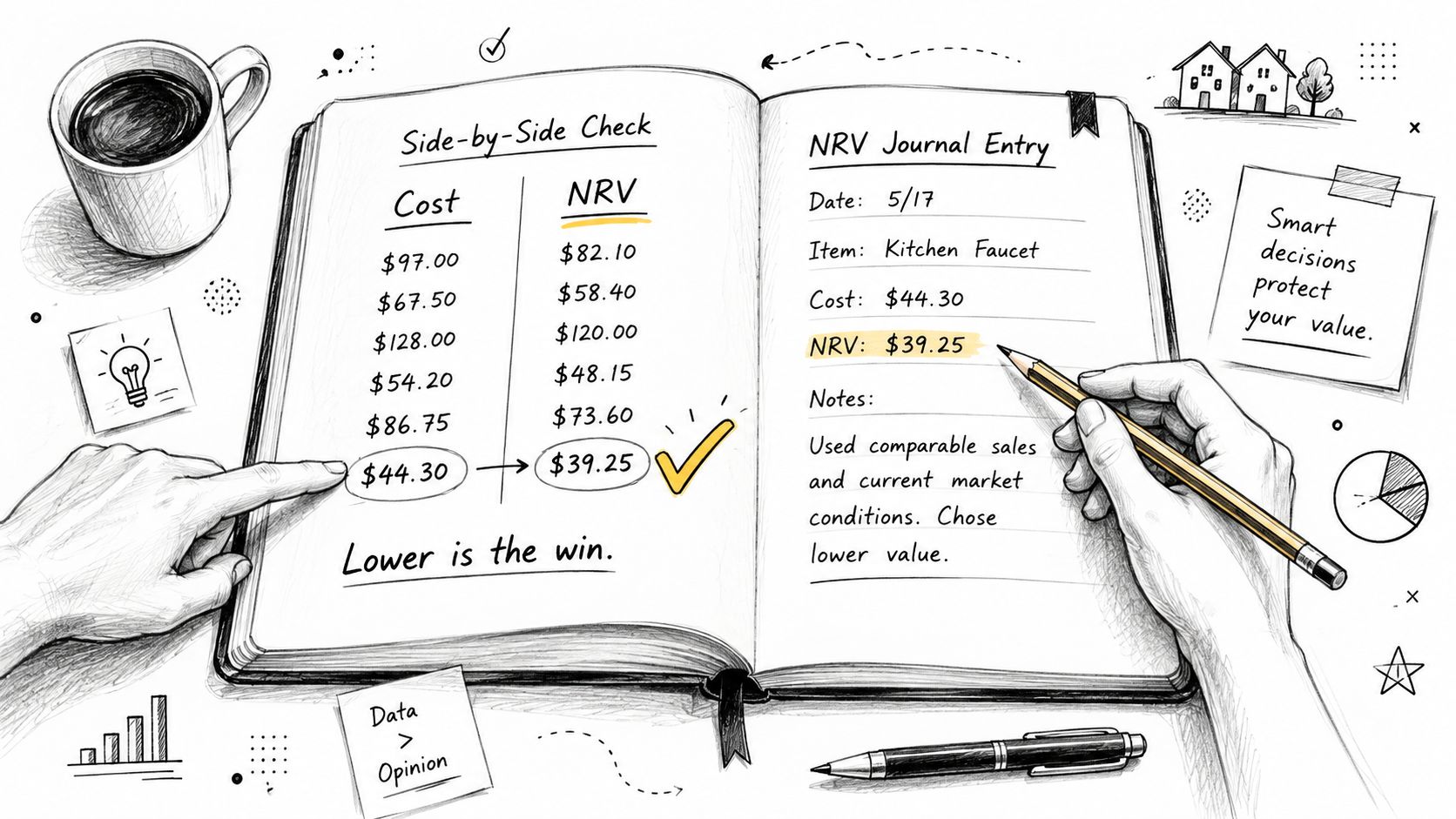
Once you have the NRV number, the next step is a comparison. Under the lower of cost or NRV rule, inventory stays on the books at whichever is lower, cost or NRV. That's the mechanism that turns the formula into an accounting entry.
If cost is higher than NRV, the business records a write-down. If cost is lower, nothing changes. The reason is simple, the balance sheet shouldn't show inventory at more than it can realistically recover. Under both U.S. GAAP and IFRS, that conservative floor keeps profit from looking stronger just because an item was bought or manufactured at a higher amount.
Here's how the entry works in practice. If inventory cost is above NRV, you record a loss or write-down expense and reduce the inventory asset. The debit usually goes to a loss on write-down or inventory expense account, and the credit reduces inventory. That shows the economic loss right away instead of waiting for the sale to happen later.
The journal entry is not about punishment. It's about matching the books to the recoverable amount as soon as the decline becomes clear.
For a bookkeeper, the workflow is usually simple. Compare cost to NRV, record the lower amount, and keep support for how you estimated the sell price and the selling costs. A plain journal-entry reference like BookkeepDIY's journal entry dictionary page can help when you want to check account naming and debit-credit structure.
If conditions improve later, the treatment depends on the reporting framework. IFRS can allow reversals of certain write-downs, while GAAP is tighter about reversals. That difference matters when inventory prices bounce back after a slowdown, so it's worth checking the reporting rules before you reverse anything.
The quick checklist is this. Confirm the asset's cost, calculate NRV, compare the two, record a write-down if NRV is lower, and keep the support attached to the entry.
How GAAP and IFRS Treat NRV Differently
The formula itself is familiar under both systems, but the reporting rules around it don't always behave the same way. That's where small business owners can get tripped up, especially if they sell across borders or prepare reports for different stakeholders. The safest habit is to separate the math from the rule set.
| Aspect | U.S. GAAP | IFRS |
|---|---|---|
| Core inventory test | Lower of cost or NRV | Lower of cost and NRV |
| Write-down floor | Inventory is reduced when NRV falls below cost | Inventory is reduced when NRV falls below cost |
| Reversal of write-downs | More restricted | More flexible in certain cases |
| Measurement style | Conservative floor for inventory valuation | Conservative floor for inventory valuation |
| Practical takeaway | Check the specific guidance before reversing or reclassifying | Same formula, but downstream reporting can differ |
The biggest practical gap shows up when a write-down might later be reversed. IFRS is more open to reversal in certain circumstances, while GAAP is more limited. That means the same item can move differently on the books depending on which framework you're reporting under.
Another area that deserves care is inventory type. Some categories can have special measurement rules, so a one-size-fits-all assumption can create mistakes. If you're not sure whether a write-down, reversal, or special category applies, that's a good moment to ask a CPA rather than rely on a generic formula sheet.
For freelancers and small businesses, the main lesson is simple. The NRV formula is shared, but the accounting outcome isn't always identical. When you work internationally, the difference can affect profit, retained earnings, and how quickly a write-down can come back.
Updating NRV When the Market Moves
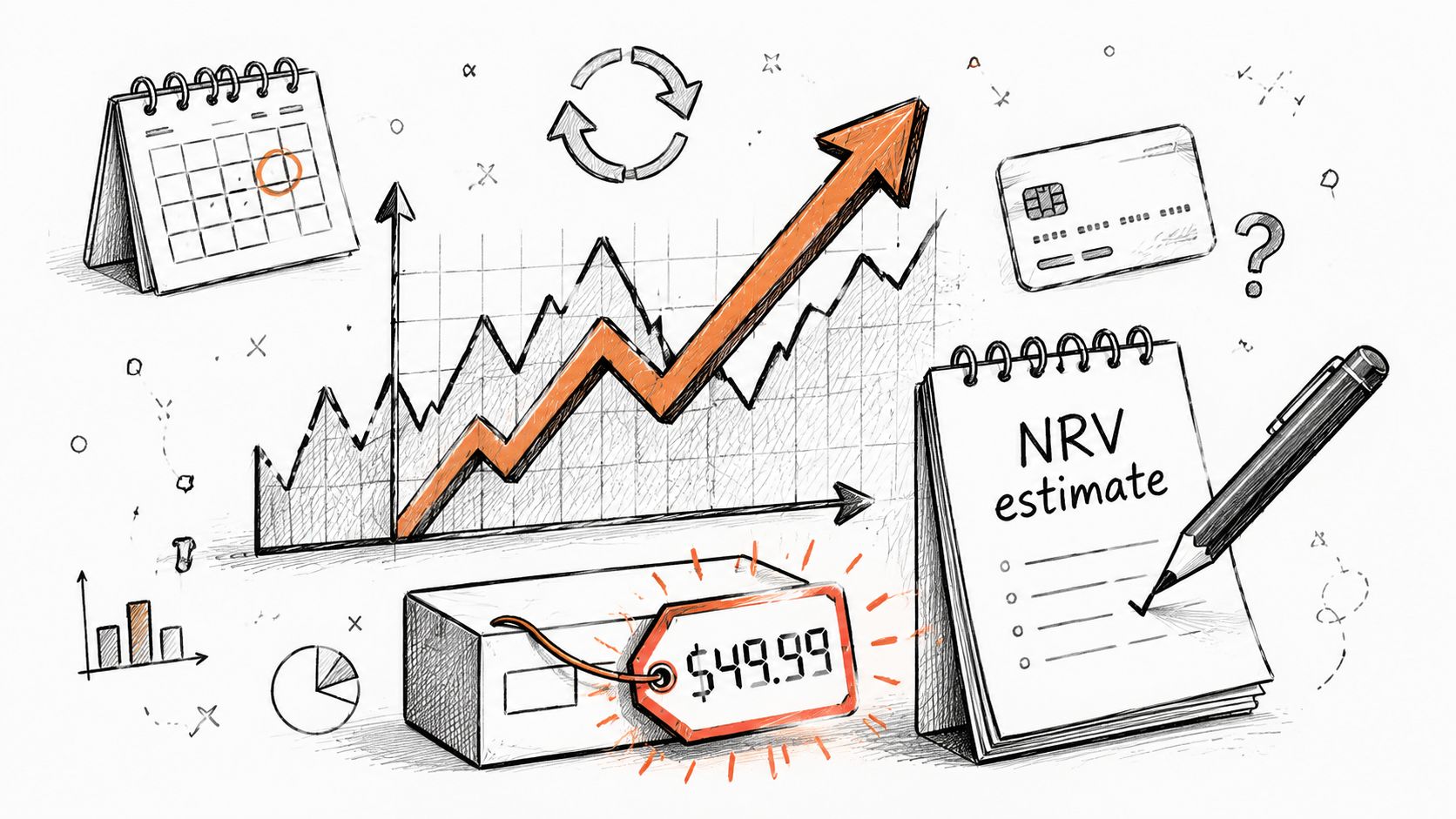
A freelancer can update pricing assumptions at the start of the month, then discover a week later that shipping rose, a customer delayed payment, or a batch of inventory is moving more slowly than expected. NRV has to follow those changes. If the inputs stay fixed while the business changes around them, the estimate stops reflecting what the asset is likely to bring in.
The same idea applies to receivables, but the selling costs are different. For inventory, NRV usually reflects the costs needed to finish and sell the item, such as labor, packaging, freight, commissions, or disposal costs. For receivables, the concern is collectability, so the estimate centers on how much cash is likely to come in after customers pay, which is why the allowance for doubtful accounts matters more than shipping or advertising. A large retailer once reported accounts receivable of $12.5 billion as the best estimate of collectible cash. The point is simple, receivables are also a moving estimate, not a set-it-and-forget-it number.
A monthly NRV refresh checklist
- Check current selling prices. Compare your expected sale amount with recent listings, quotes, or actual orders.
- Update completion costs. Revisit any labor or materials still needed before the item can be sold.
- Refresh selling costs. Recalculate commissions, shipping, packaging, advertising, and disposal-related costs.
- Review receivable collectability. Reassess the allowance for doubtful accounts when customer payment behavior changes.
- Keep notes on the change. Save the reason the estimate moved so the next close is easier to explain.
The biggest judgment call is expected selling price. Demand shifts, markdown pressure, tariffs, and returns can change that number quickly, and the same is true for direct selling costs that rise or fall with the market. A product that looked profitable last month can slip below cost if the expected cash inflow falls or the costs to complete the sale increase.
For receivables, the analysis is different. You are not estimating a resale price, you are estimating how much of the invoice will turn into cash. That is why a customer with slower payment behavior can change NRV even when the billed amount has not changed at all.
Good bookkeeping habit: Update NRV when the business changes, not just when the calendar changes.
A monthly review keeps the process from turning into an audit scramble. It also makes the estimate easier to defend because you are using recent data instead of trying to rebuild what the market looked like months ago. A simple month-end close checklist for bookkeeping can help you fold NRV into the same routine you already use for reconciliations, invoicing, and inventory counts.
Building a Monthly NRV Workflow in Your Bookkeeping Software
A useful NRV process doesn't live in a spreadsheet that gets opened once a year and forgotten. It fits into the same monthly close rhythm you already use for inventory counts, invoicing, and reconciliations. The goal is to make NRV a repeatable review, not a special project.
Start by pulling the inputs from the systems you already trust. Inventory tracking tells you what's on hand, invoicing records show what you expect to collect, and your bookkeeping file captures the write-down once you decide the number is lower than cost. The software doesn't need to guess the future, but it can help you keep the inputs organized.
A simple monthly routine
- Pull the inventory list. Flag slow-moving, damaged, or outdated items first.
- Check current selling assumptions. Compare the likely sale amount with recent activity.
- Update direct selling costs. Use current commissions, shipping, packaging, or disposal estimates.
- Review receivables separately. Revisit the allowance for doubtful accounts based on payment behavior.
- Post the adjustment. Record the write-down entry in the same period you tested NRV.
- Store support with the close. Keep the estimate notes with your month-end records.
The human review still matters most. Software can hold the data, but it can't tell you whether the market for a product changed, whether a customer's payment pattern worsened, or whether a batch should be scrapped. That judgment belongs to the person closing the books.
The best way to keep NRV manageable is to tie it to a calendar reminder and a short close checklist. A practical month-end review flow like the one in BookkeepDIY's financial month-end close checklist software guide can help you fold NRV into the rest of your bookkeeping routine without making it feel like a separate project.
Bottom line: NRV works best when it's reviewed every period, documented clearly, and adjusted from current data instead of memory.
If you want a cleaner way to handle bookkeeping terms, software selection, and month-end processes without second-guessing the accounting language, visit BookkeepDIY. It's built to help freelancers and small businesses make better bookkeeping decisions with less jargon and more clarity.