
Most restaurant bookkeeping advice starts with “track your expenses.” That's necessary, but it misses the expensive part of the job. A restaurant can record every vendor bill and still have unreliable books if the POS, payroll system, payment processor, gift-card records, and delivery channels don't reconcile to the ledger.
The practical question is simpler: can you explain yesterday's sales, cash, tips, discounts, inventory movement, labor, and bank deposits before the next service begins? If you can, bookkeeping becomes an operating control. If you can't, month-end reports may only confirm that money leaked somewhere.
Why Restaurant Bookkeeping Is Really a Margin Control System
Restaurant bookkeeping is often treated as administrative cleanup. That approach fails because restaurants operate with unusually little room for posting errors, waste, scheduling mistakes, and payment timing differences. Food cost commonly falls within 28% to 35% of revenue for full-service restaurants, while labor has a median of 36.5% of sales. Together, food and labor form prime cost, which typically runs about 60% to 65% of sales according to restaurant industry benchmarks.
That leaves a narrow margin for everything else, including rent, utilities, insurance, repairs, merchant fees, taxes, and debt service. The same benchmark source places the median pre-tax net margin for full-service restaurants at about 2.8%, so a small unexplained variance can matter far more than it would in a less cost-heavy business.
The ledger should answer operational questions
A useful restaurant ledger helps an owner decide:
- Should tonight's schedule be reduced? Compare labor already incurred with sales and the remaining forecast.
- Is a food-cost increase real? Separate price changes, waste, portioning, transfers, and inventory-count errors.
- Did the busy weekend generate cash? Reconcile sales by payment channel with settlement timing and outstanding liabilities.
- Can the business cover upcoming obligations? Review vendor bills, payroll, taxes, rent, and delayed delivery-platform payouts together.
Generic bookkeeping waits for transactions to accumulate. Restaurant bookkeeping for restaurants should work in the opposite direction. The daily close creates a reliable starting point, the weekly review identifies drift, and the monthly close formalizes the story for reporting and compliance.
Practical rule: A report that arrives too late to change purchasing, scheduling, or cash decisions is historical evidence, not operational control.
Prime cost is the early warning signal
Prime cost deserves attention because it combines the two largest controllable expense groups. Industry summaries place restaurant profit margins broadly in the 3% to 9% range, with food cost commonly around 25% to 35% of revenue and labor around 20% to 30% or higher, depending on the format, as outlined in restaurant bookkeeping guidance.
Those ranges aren't targets to copy blindly. They're a reason to establish concept-specific expectations, measure consistently, and investigate movement quickly. A full-service restaurant, a fast-casual operation, and a bar may have different staffing patterns, product mixes, and service charges.
The control system also has to follow cash timing. A profitable sales day may produce a bank deposit later, while payroll, vendor invoices, taxes, and rent may leave the account on fixed dates. Weekly bookkeeping gives the operator time to respond. Month-end-only bookkeeping often shows the problem after the cash decision has already been made.
Building a Restaurant-Specific Chart of Accounts
A chart of accounts should mirror the way the restaurant is managed, not the default categories generated by a small-business accounting wizard. If food, beverage, labor, gift cards, tips, and delivery activity all land in broad accounts, the P&L may look tidy while hiding the causes of margin movement.
Start with revenue. Separate food sales, beverage sales, catering or private events, merchandise, and other operating revenue when those channels have different costs or settlement patterns. Keep discounts, comps, refunds, and voids visible rather than burying them in a single net-sales figure. A manager should be able to connect a sales report to the general ledger without guessing.
Build cost categories around decisions
Use separate cost-of-goods-sold accounts for the categories that influence ordering and menu decisions:
- Food COGS: Meat, produce, dairy, dry goods, and other kitchen ingredients.
- Beverage COGS: Beer, wine, liquor, coffee, and nonalcoholic beverages.
- Packaging and disposables: Takeout containers, napkins, cups, and other direct service supplies.
- Other direct costs: Include only items directly tied to producing or delivering the sale.
Labor needs similar clarity. Separate front-of-house wages, back-of-house wages, management salaries, payroll taxes, benefits, and other employer-paid labor costs. Tipped wages and tip liabilities require special handling, so a single “payroll” account won't tell you whether a labor problem came from scheduling, overtime, payroll burden, or tip settlement.
Occupancy should stand apart from controllable operating costs. Rent, common-area charges, utilities, insurance, repairs, linen, cleaning, marketing, licenses, and professional fees each tell a different management story.
Don't forget the balance sheet
Several accounts aren't expenses at all:
- Gift card liability: Cash received before the customer redeems the stored value.
- Tips payable: Amounts collected for employees but not yet paid out.
- Sales tax payable: Tax collected on behalf of the relevant authority.
- Credit-card clearing: Temporary holding accounts for card sales awaiting settlement.
- Delivery-platform receivable: Amounts owed after a third-party channel records sales but before funds arrive.
Use clear naming conventions, such as Food COGS, Beverage COGS, FOH Wages, BOH Wages, Tips Payable, and Gift Card Liability. Consistent names make recurring journal entries easier to review and help managers understand reports without accounting jargon. For plain-language help with account structure, use this chart of accounts definition.
The best chart isn't the longest one. It has enough detail to calculate prime cost, explain payment differences, and compare operating decisions without forcing staff to code every invoice into an unnecessarily narrow category.
Daily, Weekly, and Monthly Close Checklists
The close rhythm should match the speed of service. A restaurant that waits until the end of the month to reconcile sales is asking memory and incomplete reports to explain transactions that may already be difficult to trace.
Daily close
The closing manager should complete the same sequence after each service:
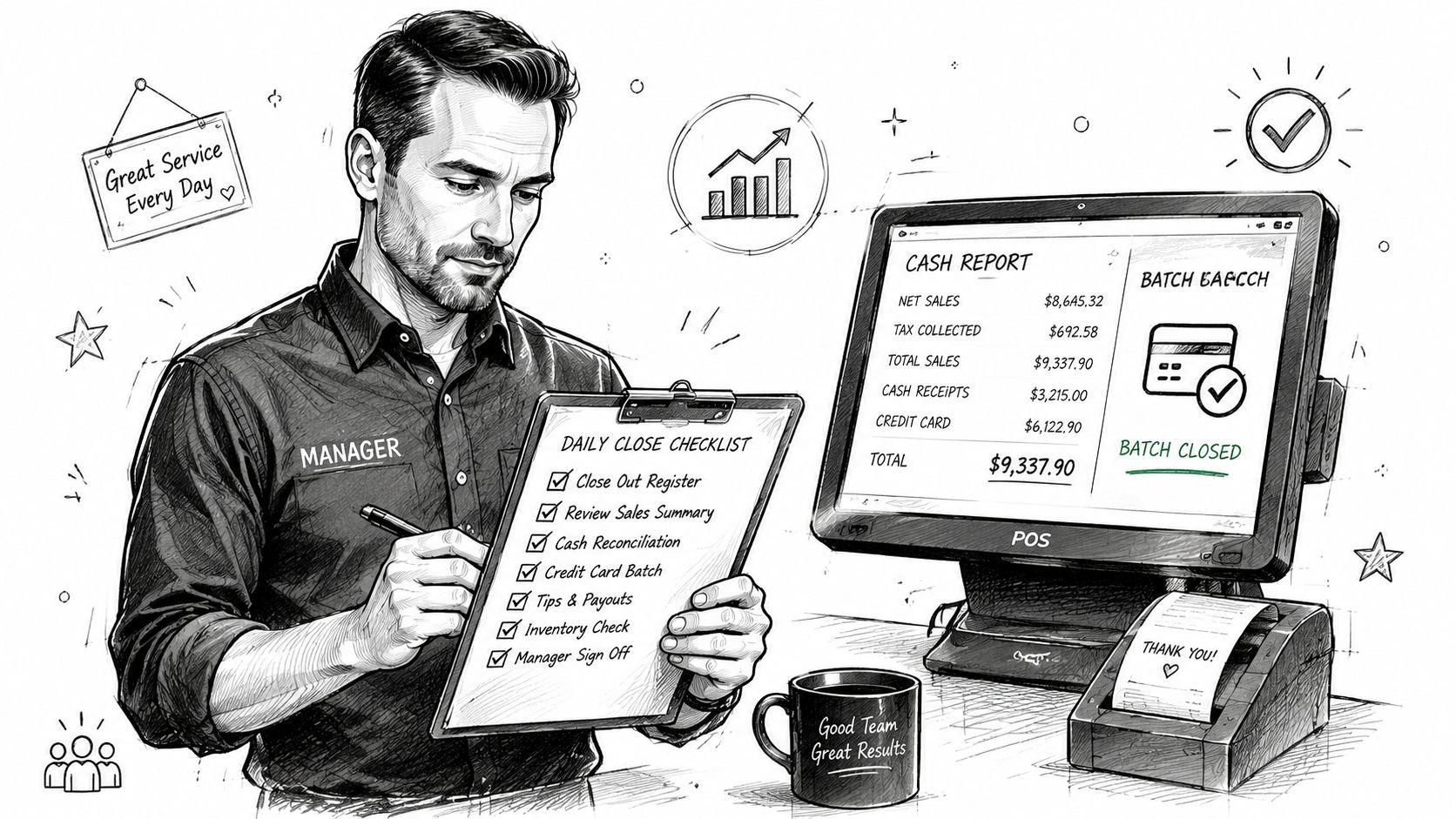
- Lock the POS day. Confirm sales, refunds, discounts, comps, voids, service charges, tips, and payment types before anyone edits the record.
- Count the drawer. Compare the physical cash to the POS cash report. Investigate variances above the preset threshold. One hospitality control framework recommends investigating variances over $5, requiring manager sign-off over $20, and treating repeated employee-specific patterns as a serious disciplinary trigger. See the restaurant financial controls guidance for the full control approach.
- Reconcile card activity. Match the POS card totals to the processor batch or settlement report, then record fees and timing differences in a clearing account.
- Review exceptions. Require an explanation for unusual comps, large discounts, manual refunds, deleted items, and reopened checks.
- Record the deposit plan. Note what was deposited, what remains in the drawer, and what is still awaiting card settlement.
Weekly control loop
A weekly review should combine operations and accounting rather than treating them as separate meetings.
- Count inventory with dual verification. Record quantities, units, prices, transfers, waste, and spoilage consistently.
- Compare theoretical and actual usage. Theoretical usage comes from sales multiplied by recipe yields. Investigate category variances above 3%, following the control recommendation in the hospitality reference linked above.
- Review labor against sales. Include approved hours, overtime, payroll taxes, and benefits, then compare results with the concept's own trend.
- Update the cash forecast. A rolling 13-week forecast is recommended in current restaurant cash-management guidance because monthly reporting can arrive too late for payroll, rent, invoices, and delayed settlements. The recommendation and related labor discussion appear in restaurant labor cost coverage.
- Post open bills and investigate missing invoices. Unrecorded purchases make both cash planning and COGS unreliable.
For a repeatable close process, keep a shared financial month-end close checklist and assign each task to a named person.
Monthly close
The monthly close should reconcile every bank and credit-card account, review receivables and liabilities, post accruals, prepare sales-tax support, and analyze the P&L by revenue channel and cost category. Compare the current period with the prior period and the restaurant's operating expectations.
Don't close a month just because every account has a green checkmark. Ask whether the ledger explains inventory movement, payroll timing, outstanding gift cards, delivery receivables, and unusual discounts. A clean close is one that a manager can use to make the next operating decision.
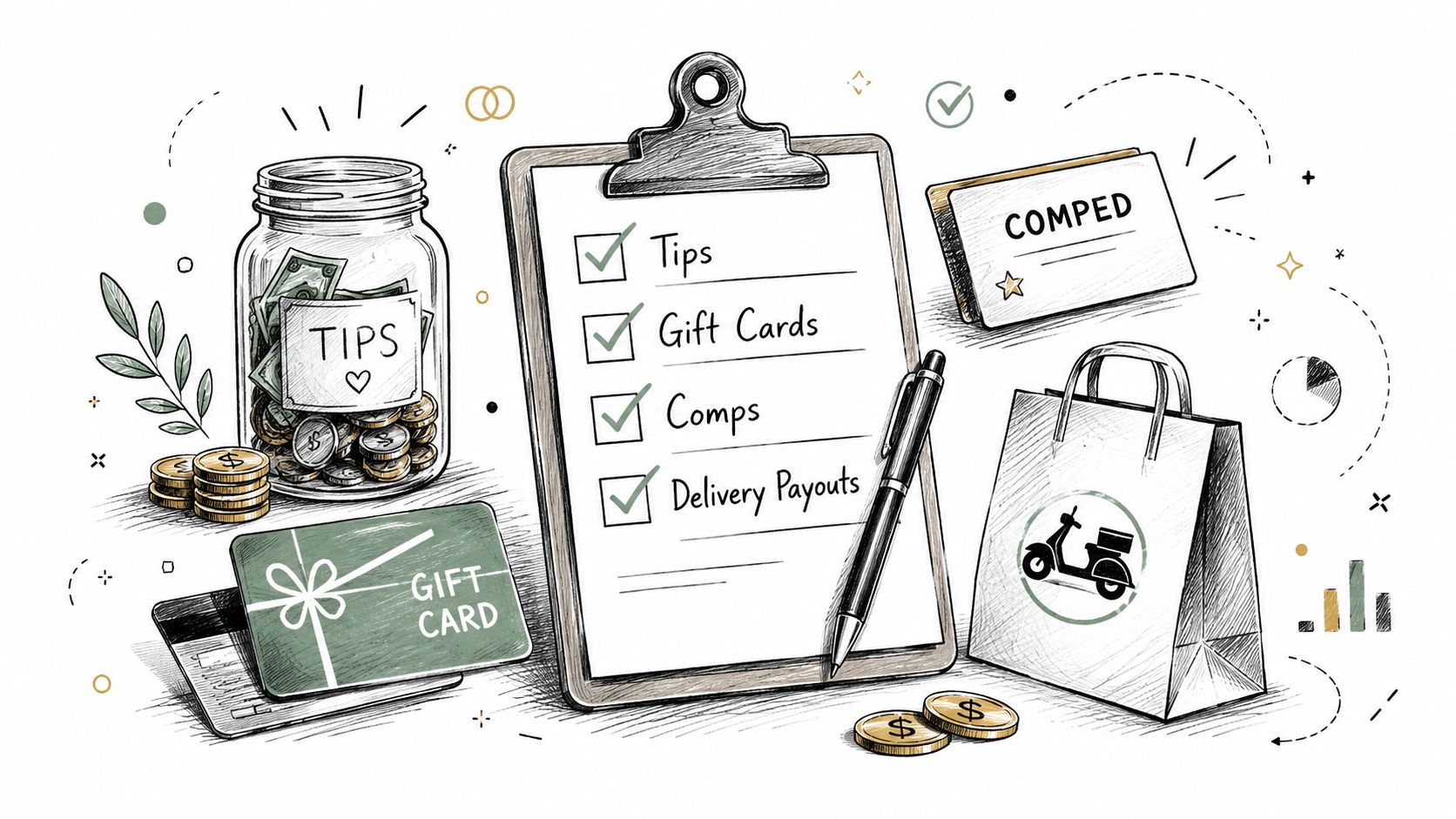
Reconciling Tips, Gift Cards, Comps, and Delivery Payouts
The bank deposit rarely equals the POS sales total, and that isn't automatically a mistake. The POS may record gross sales, tips, taxes, gift-card activity, discounts, and delivery orders, while the bank receives net settlements after fees, refunds, chargebacks, or timing delays.
The fix is a daily settlement bridge. Start with the POS report, separate revenue from liabilities and contra-revenue, match each payment channel to its settlement report, and post the difference to a clearing, fee, receivable, or payable account that has a clear explanation.
Tips and service charges
Credit-card tips aren't restaurant revenue. Record them as a liability until they're paid to employees, with payroll handling the related reporting and employer obligations. Cash tips may follow a different operational process, but the books still need to reflect the amounts collected, distributed, or retained according to the restaurant's policy and local requirements.
Service charges need a written accounting policy. Depending on how the charge is described, controlled, and distributed, it may be restaurant revenue, an amount owed to staff, or a combination requiring separate accounts. Don't label every service charge as a tip or every tip as revenue. The POS configuration, guest-facing language, payroll treatment, and local rules must agree.
Gift cards, comps, and voids
Gift-card sales generally create a liability because the restaurant has received money before providing the meal. Record the sale as deferred value, then recognize revenue when the card is redeemed under the applicable accounting policy. Keep sales and redemption reports available for reconciliation.
Comps and discounts reduce the value of the sale and should remain visible as contra-revenue. A manager comp isn't the same as a marketing expense just because it was intentional. Void activity should also remain traceable, with the original item, reason, authorizer, and timing available for review.
Delivery settlements
For third-party delivery orders, record the underlying sale by the appropriate revenue category, then record commissions, processing fees, refunds, and other deductions separately. The resulting receivable should reconcile to the settlement statement, while the bank deposit should reconcile to the settlement amount after the stated deductions.
A detailed resource on restaurant delivery finance reconciliation is useful when delivery reports and bank deposits keep disagreeing. The principle is straightforward: don't force the deposit to equal revenue. Reconcile the path between them.
A reliable reconciliation doesn't eliminate differences. It assigns every difference to a named account with a documented reason.
Tracking Prime Cost, COGS, and Tipped Payroll
Prime cost is useful only when the inputs reflect reality. Start with inventory, purchases, sales, and fully loaded labor. For each COGS category, use:
Beginning inventory + purchases − ending inventory = COGS
Calculate food and beverage separately when the purchasing and menu decisions differ. Include transfers, spoilage, staff meals, and waste in the operational records so the theoretical comparison isn't distorted by missing movement.
Use a moving view, not one noisy week
A single week can be misleading because deliveries, inventory counts, holidays, vendor timing, or an unusual event may shift costs between periods. Compare the current result with a 4-week moving average, as recommended in restaurant operating cost guidance.
For theoretical usage, take each item sold, apply the recipe quantity and yield, and compare the expected depletion with actual inventory movement. A difference can indicate waste, portion inconsistency, unrecorded transfers, counting errors, theft, or a recipe that no longer matches production. Don't jump straight to blame. First test the data and the unit conversions.
Count labor as a fully loaded cost
Labor should include wages, payroll taxes, benefits, overtime, and other employer-paid costs. Tipped employees still create labor expense and administrative obligations even when guests provide part of the compensation. Track regular hours, overtime, role, location, and payroll period so the weekly review shows what management can control.
| Restaurant concept | Food cost % of sales | Labor cost % of sales | Target prime cost % of sales |
|---|---|---|---|
| Full-service restaurant | 28%–35% | 36.5% median | 60%–65% |
| Limited-service restaurant | Concept-specific | Concept-specific | About 65% |
| Other formats | 25%–35% commonly reported | 20%–30% or higher | 55%–65% healthy benchmark |
The full-service food, labor, and prime-cost figures come from restaurant industry benchmark data, while the broader prime-cost range is summarized in the restaurant ratios guide. The table is a starting point, not a universal budget. Compare the result with your own menu mix, service model, staffing pattern, and moving average.
When prime cost drifts upward, choose the response based on the cause. Recheck purchasing and yields when food cost moves. Adjust schedules and deployment when labor is the driver. Review menu pricing or product mix when the restaurant is selling items that no longer support their production burden. The goal isn't to cut blindly. It's to stop the leak closest to its source.
Choosing the Right Bookkeeping Tools for Your Restaurant
Restaurant technology should reduce reconciliation work, not create another report that someone must manually interpret. Start with the workflow, then choose tools that connect the workflow from sale to settlement to ledger.
Match the category to the job
A practical stack usually includes several functional categories:
- Accounting and bookkeeping: General ledger, bank reconciliation, journal entries, financial statements, and account structure.
- Payroll: Time capture, tipped payroll, tax calculations, and labor reporting.
- Expense management: Receipt capture, approvals, card controls, vendor coding, and recurring expenses.
- POS and bank integrations: Daily sales imports, payment-channel detail, settlement matching, and deposit tracking.
- Tax preparation and compliance: Sales-tax support, payroll filings, documentation, and reporting workflows.
BookkeepDIY catalogs and compares finance back-office tools across categories including Accounting & Bookkeeping, Payroll, Expense Management, and Tax Preparation & Compliance. Its listings use pricing-model labels and plain-language summaries, which helps non-specialists narrow the field before they spend time in product demonstrations.
Evaluate the handoffs
Ask each provider to demonstrate the exact restaurant workflow, not just a generic dashboard:
- Can the system separate food, beverage, delivery, gift-card, and other revenue?
- Can it preserve tips, service charges, comps, voids, and discounts as distinct data?
- Does it post processor fees and settlement timing without burying the difference?
- Can managers review labor by role, location, and pay period?
- Does multi-location reporting preserve each restaurant's costs and liabilities?
- Can staff export an audit trail when a number changes?
Pricing labels such as Paid, Free trial, Freemium, and Contact sales are useful for initial screening, but price alone won't reveal implementation effort. A low-cost system that requires daily spreadsheet repair may cost more in staff time than a pricier system with dependable integrations.
For a familiar accounting workflow, review the QuickBooks Online tool overview, then read independent technical guidance such as the NAS Ledger accounting platform blog. The right choice is the one your team can configure, reconcile, and maintain consistently.
Common Bookkeeping Mistakes and How to Avoid Them
The same errors appear in independent restaurants because the transaction flow is complex and the close is often assigned to whoever has time. Prevention depends less on accounting sophistication than on assigning each recurring mismatch a control owner.
Mistakes that distort the P&L
Recording deposits as sales makes revenue appear lower or higher depending on fees, tips, taxes, refunds, and settlement timing. Post the POS activity by category, use clearing accounts for unsettled payments, and reconcile the bank deposit to the settlement report.
Treating gift-card proceeds as immediate revenue ignores the obligation to provide a future meal. Maintain a gift-card liability and reconcile sales, redemptions, adjustments, and outstanding balances.
Hiding comps and voids in net sales removes the information managers need to evaluate discounts and authorization behavior. Keep contra-revenue accounts and review exception reports daily.
Posting all labor to one account hides whether the problem came from front-of-house scheduling, kitchen coverage, overtime, payroll taxes, or management compensation. Separate the categories that drive decisions.
Mistakes that create cash surprises
Ignoring delivery settlement timing causes owners to mistake a delayed receivable for missing sales. Reconcile gross orders, commissions, refunds, and net deposits through a dedicated settlement account.
Waiting for month-end to review food cost gives waste, purchasing changes, and portion problems too much time to continue. Count inventory weekly, compare theoretical with actual usage, and investigate category variances above the established threshold.
Leaving tips and service charges ambiguous creates both liability and reporting problems. Define the policy, configure the POS accordingly, and reconcile the amounts to payroll or distribution records.
Skipping the cash forecast leaves the owner reacting to payroll, rent, taxes, invoices, and delayed deposits after the bank balance has already tightened. Update the rolling forecast during the weekly review.
A high-impact weekly routine can fit on one page:
- Close the prior week: Confirm POS, cash, card settlements, tips, discounts, comps, and voids.
- Count and compare: Verify inventory, post purchases, and review theoretical versus actual usage.
- Measure labor: Include fully loaded costs and compare labor with sales and the recent trend.
- Review liquidity: Update expected deposits, bills, payroll, taxes, and other near-term commitments.
- Assign actions: Name the person responsible for each variance and set the next review date.
Good bookkeeping isn't perfect history for its own sake. It's a system that helps the owner catch the next margin surprise while there's still time to change the order, schedule, menu, or cash plan.
BookkeepDIY helps small-business operators compare bookkeeping, payroll, expense-management, and tax-compliance tools using plain-language summaries and pricing-model labels. Visit BookkeepDIY to shortlist finance tools that can support cleaner restaurant reconciliations and a more dependable daily control routine.