
You're doing the work. The sale is made. The invoice is sent. Then you open your bank account and feel that drop in your stomach, because the cash still isn't there.
That's where many small business owners get stuck. On paper, the business looks healthy. In real life, you're delaying owner pay, waiting to buy supplies, or moving money around just to cover payroll and rent. Cash flow is the lifeblood of a business, and accounts receivable is the part of the circulatory system that's supposed to bring that blood back in.
If you're a freelancer, shop owner, consultant, contractor, or service business owner, accounts receivable management doesn't need to feel like corporate finance jargon. It's the habit of making sure money owed to you arrives, on time, with as little friction and relationship damage as possible.
Why Managing Your Receivables Is Crucial for Survival
A lot of owners learn this lesson the hard way.
You finish a project, deliver a product, or complete a month of work for a reliable client. You send the invoice and expect payment soon. A week passes. Then two. Meanwhile, your bills don't wait. Your software subscriptions, payroll, rent, and taxes still come due. You can have a profitable month and still feel broke.
That's the heart of accounts receivable. Accounts receivable means money your customers owe you for work you've already completed or goods you've already delivered. It counts as an asset in your books, but it doesn't pay your electric bill until it turns into cash.
Practical rule: Profit on a report and cash in the bank are not the same thing.
Small businesses often treat receivables as an after-the-fact bookkeeping task. They send an invoice, hope for the best, and only follow up once the situation feels urgent. That's like waiting until the lifeblood is already draining out before checking the wound.
Managing receivables means staying involved from the start. You set clear terms. You invoice promptly. You follow up consistently. You track what's current, what's overdue, and what's turning into a dispute. That active process is what turns paper income into spendable cash.
For a small business, this isn't just about neat records. It affects your ability to:
- Cover fixed costs: Rent, payroll, software, insurance, and taxes don't pause because a client is slow.
- Make calm decisions: Good cash flow gives you room to think. Poor cash flow forces rushed choices.
- Protect growth: A growing business can strain itself if sales rise but collections lag behind.
- Keep relationships intact: A clear process prevents payment conversations from becoming emotional.
When owners say, “I'm busy, but the bank balance doesn't show it,” they're usually describing an accounts receivable problem.
Understanding the Accounts Receivable Lifecycle
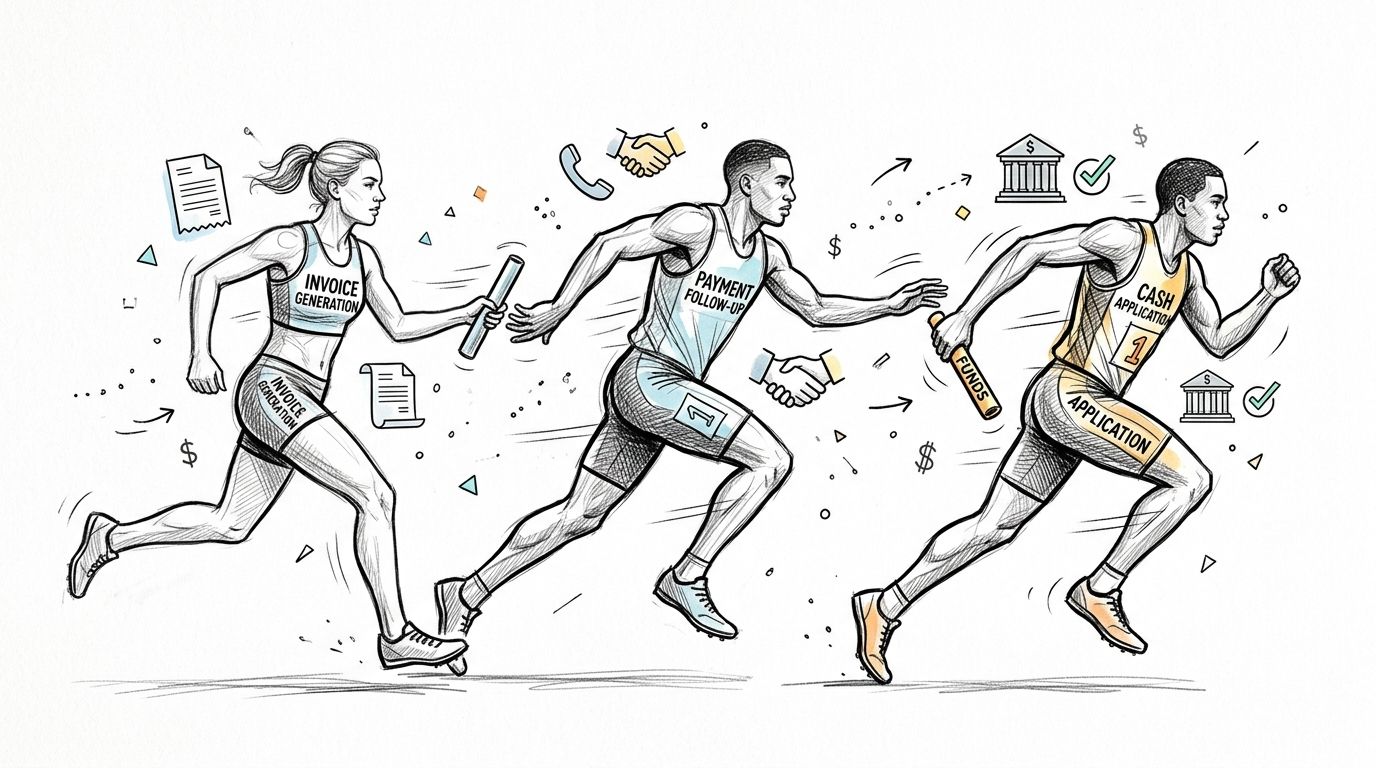
Accounts receivable management works best when you stop seeing it as one task and start seeing it as a flow. I like to explain it as a three-stage relay race. If one runner drops the baton, cash slows down.
If you want a plain-language definition first, BookkeepDIY's accounts receivable dictionary entry gives a helpful baseline. The important part is what happens after the invoice exists.
Stage one is invoicing
The first runner carries the baton out of the gate. You then create and send the invoice.
A surprising number of payment problems begin here. The invoice goes out late. It's missing a purchase order number. The due date isn't obvious. Payment instructions are vague. The customer doesn't know who to contact with questions. Then the invoice sits in someone's inbox while your cash flow stalls.
A strong invoice does a few basic things well:
- States the due date clearly: Don't make the customer guess when payment is expected.
- Describes the work plainly: Short, specific line items reduce confusion and disputes.
- Includes payment instructions: Tell them exactly how to pay.
- Shows contact details: If there's a question, they should know who to email right away.
Send invoices promptly. If you wait until the end of the week, or the end of the month, you've already delayed your own cash.
Stage two is collections
Many small business owners often tense up. Collections sounds harsh, but for most small businesses it means professional follow-up.
You're not trying to bully a customer. You're keeping the lifeblood moving.
Collections starts before an invoice becomes a problem. A friendly reminder before the due date can prevent a late payment. A polite note a few days after the due date keeps momentum going. If a customer still hasn't paid, your tone can become firmer without becoming rude.
The goal isn't to “chase” people. The goal is to remove delay, confusion, and avoidance.
Good collections work because it's consistent. Customers learn that your business notices unpaid invoices and communicates calmly. That expectation alone changes behavior.
Stage three is reconciliation
The last runner crosses the finish line. Reconciliation means matching the payment you received to the correct invoice and updating your records.
This step sounds boring, but it matters. If you don't record payments correctly, you may follow up on an invoice that was already paid, miss a short payment, or fail to spot a customer who's carrying old balances.
Reconciliation should answer three questions:
- Did the payment arrive?
- Which invoice or invoices did it apply to?
- Is the balance now fully paid, partially paid, or still open?
Here's the relay race in simple form:
| Stage | What happens | Why it matters |
|---|---|---|
| Invoicing | You bill clearly and on time | Starts the payment clock correctly |
| Collections | You follow up with purpose | Keeps payment from drifting |
| Reconciliation | You match cash to invoices | Closes the loop and keeps records clean |
When these three stages work together, accounts receivable management stops feeling reactive. It becomes a repeatable routine.
How to Measure Your Accounts Receivable Performance
You don't need a finance degree to tell whether your receivables process is healthy. You just need a few numbers that answer practical questions: How long does it take to get paid? How well are we collecting what's due? Where are invoices getting stuck?

DSO tells you how long cash takes to come home
Days Sales Outstanding, or DSO, is the simplest way to think about collection speed. In plain English, it tells you how many days it takes, on average, to collect after a sale.
If your DSO is creeping upward, the lifeblood of the business is moving more slowly. You may be making sales just fine, but the cash is lagging behind.
Small business owners often stop there because DSO feels easy to understand. That's useful, but it doesn't always tell the full story. A sales-heavy month can make the picture look better or worse than your actual collection effort deserves.
CEI shows how effective your collection process really is
Collection Effectiveness Index, or CEI, offers a more helpful perspective. CEI focuses on how much of the receivables available to collect you collected during a period. It's calculated as [(Beginning AR + Monthly Credit Sales - Ending Total AR) / (Beginning AR + Monthly Credit Sales - Ending Current AR)] × 100 according to Esker's explanation of key AR metrics.
That same source notes that top-performing organizations achieve CEI levels of 90 to 95, and that in 2026 finance leaders prioritize 85% or higher as a sign of highly efficient collection operations. It also notes that a 5% increase in CEI typically reduces DSO by 1.5 to 2 days. In one example, a mid-sized firm improved CEI from 78% to 88%, reduced DSO from 45 to 39 days, and increased free cash flow by $120,000 annually.
Why does that matter to a small business owner? Because CEI helps you separate two different realities:
- Sales are growing.
- Collections are improving.
Those are not always the same thing.
What CEI helps you see: DSO can move because sales volume changes. CEI is more focused on how well you collected what was available to collect.
The aging report is your diagnostic tool
If DSO is the dashboard light and CEI is the engine test, the accounts receivable aging report is the mechanic's worksheet.
An aging report groups unpaid invoices by how long they've been outstanding, often in buckets such as current, 30 days, 60 days, and 90 days past due. You don't need fancy software to use it well. You need the discipline to review it regularly.
Look for patterns such as:
- A client that's always late: That may point to weak terms or a customer-specific follow-up issue.
- A sudden pile-up in one age bucket: That often means reminders aren't going out on time.
- Old balances that never move: Those may be disputes, documentation problems, or likely bad debt.
Aging reports turn a vague feeling of “people are paying slowly” into a list of specific accounts that need attention.
Common Accounts Receivable Mistakes to Avoid
The biggest receivables mistakes usually don't come from ignorance. They come from hesitation.
Small business owners know they should invoice faster, follow up sooner, and document disputes better. What gets in the way is emotion. They don't want to seem pushy. They don't want to annoy a good client. They don't want a payment conversation to damage a working relationship.
That fear is common. Data from 2024 to 2025 shows that for 68% of small businesses with DSO over 60 days, “awkward follow-up” is the primary barrier to collection, according to this discussion of small-business AR challenges.
Waiting because the client is “nice”
A polite client can still be a slow-paying client.
Owners often give extra grace to customers they like. They tell themselves the customer is busy, traveling, or dealing with internal approval delays. Weeks pass. The invoice gets older. The relationship starts carrying unspoken tension because now the amount due feels large enough to be uncomfortable.
Friendly follow-up isn't rude. Silence is what creates strain.
If you need a more structured process, BookkeepDIY's accounts receivable collections resources can help you think in terms of workflow rather than emotion.
Sending invoices that raise questions
Some invoices practically invite delay. They use vague descriptions, unclear dates, or missing backup documents. The customer has a reason to pause, ask a question, or send the bill to the wrong person.
When an invoice creates confusion, the payment clock may stop without anyone telling you.
Common examples include:
- Unclear service descriptions: The client can't tell what they're being billed for.
- Missing approvals or references: Internal payables teams may hold the invoice.
- No payment instructions: The customer intends to pay, then puts it aside.
Treating follow-up as random instead of routine
A lot of owners follow up based on mood. If they're busy, they wait. If they feel bold, they send a note. If they feel awkward, they avoid it another week.
That inconsistency trains customers to think your due dates are flexible.
A payment process feels professional when it happens the same way every time.
Ignoring small overdue balances
A modest balance can feel too small to bother with. But a receivables ledger full of small old invoices can gradually choke cash flow.
Small balances also teach customers what your business tolerates. If they learn nothing happens when they underpay or delay payment on a smaller invoice, they may repeat that pattern on larger ones.
Letting disputes live in email threads
When a customer questions an amount, many small businesses handle it informally. A few emails go back and forth. Someone promises to check on it. Then the issue sits there half-resolved.
That's dangerous because a dispute often freezes payment momentum. Once the invoice is in limbo, your cash flow is waiting on memory, inbox searching, and whoever happens to be available that day.
Practical Steps for Better Accounts Receivable Management
Good accounts receivable management doesn't require a huge finance department. It requires a repeatable system that protects both your cash flow and your customer relationships.
One of the clearest weak spots for small businesses is dispute handling. Recent data from 2025 indicates that 42% of small business invoice disputes remain unresolved beyond 90 days because standardized documentation and escalation protocols are missing, leading to an estimated $1.2B in unrecovered revenue annually, according to Allianz Trade's discussion of AR management challenges. That tells you something important. Most collection problems aren't just about unwilling customers. They're also about unclear internal process.
Start with a simple operating checklist
Here's a practical baseline you can use right away.
| Area | Action Item | Why It Matters |
|---|---|---|
| Invoicing | Send the invoice as soon as work is delivered | Faster billing starts the payment cycle sooner |
| Invoicing | Include due date, amount, scope, and payment instructions | Clear invoices create fewer excuses for delay |
| Customer setup | Confirm billing contact before sending the first invoice | The invoice reaches the right person the first time |
| Follow-up | Schedule reminders before and after due dates | Consistency removes guesswork and delay |
| Reconciliation | Match every payment to the correct invoice promptly | Prevents false overdue notices and missed short pays |
| Disputes | Log every issue in one place | Stops disputes from getting lost in email |
| Escalation | Decide in advance when to move from reminder to firm collection action | Protects cash flow and removes hesitation |
Use a phased reminder system
You don't need aggressive language. You need a sequence.
Try this approach:
Before due date
Send a short courtesy reminder. Keep it light and factual.Example:
“Hi [Name], just a quick note that invoice [number] is due on [date]. I'm sending this early in case your team needs anything to process it. Thanks.”Shortly after due date
Assume good intent first.Example:
“Hi [Name], I'm following up on invoice [number], which was due on [date]. I wanted to check whether payment is already in process or whether you need anything from me to complete it.”Further past due
Become more direct. Stay calm.Example:
“Hi [Name], invoice [number] remains outstanding. Please send an update on payment timing by [day]. If there's an issue with the invoice, let me know today so we can resolve it.”Escalation stage
State the next step clearly.Example:
“Hi [Name], I haven't received payment or a resolution update on invoice [number]. Please reply by [day] with payment confirmation or details of any dispute. If I don't hear back, I'll need to move this to the next step in our collections process.”
The magic isn't in perfect wording. It's in sending these messages on schedule.
A useful mindset: You're not creating pressure out of nowhere. You're enforcing an agreement that already exists.
Keep a dispute log
If a customer raises any issue, don't let it float around in email. Create a simple dispute log in a spreadsheet or shared document.
Track these fields:
- Invoice number
- Customer name
- Date dispute was raised
- Issue description
- Who owns the follow-up
- Documents needed
- Next contact date
- Current status
- Resolution notes
This one habit makes a big difference. It gives you a record, a timeline, and a clear handoff if someone else needs to help.
Set escalation thresholds in advance
Owners freeze up when they have to decide in the moment whether an unpaid invoice has crossed the line. Remove that stress by setting your thresholds now.
For example, decide:
- When a reminder becomes a firm collection notice
- When a disputed invoice requires supporting documents
- When a customer account should pause new work until old balances are addressed
- When an outside collection partner or legal advice should be considered
You don't need to be dramatic about it. You just need rules that protect the lifeblood of the business.
Build scripts that sound like you
Template language should feel natural, not robotic. If your business is warm and personal, keep your reminders warm and personal. If your business is formal, keep them crisp and direct.
The goal is consistency. Customers should recognize that your payment communication is part of how your business operates, not a burst of frustration when you get tired of waiting.
How AR Software Streamlines Your Workflow
Manual accounts receivable management can work when volume is low and every customer interaction lives in your head. That starts to break down as soon as invoices pile up, customers pay in different ways, or disputes overlap.
Software helps by turning scattered habits into a workflow.
Look for automation that still feels human
For a small business, the best automation doesn't replace relationships. It supports them.
Useful features usually include:
- Automated invoicing: Recurring or one-click invoice creation reduces delays.
- Scheduled reminders: Follow-ups go out on time even when you're busy.
- Payment links or portals: Customers can pay without back-and-forth email.
- Status tracking: You can see what's sent, viewed, overdue, disputed, or paid.
Many owners don't struggle with knowing what to do. They struggle with doing it every single time.
Reporting should help you act, not just observe
A good AR workflow tool should also make the health of your receivables visible. You want to spot trouble early, not after cash gets tight.
That usually means looking for:
- Aging visibility: So you can see overdue balances grouped by age
- Payment history by customer: So you can identify slow-pay patterns
- Open invoice tracking: So nothing disappears into the cracks
- Basic dashboard views: So you don't have to build reports from scratch
When software gives you a clean picture, you make better decisions faster. You know which customer needs a reminder, which invoice needs backup documents, and which balance needs escalation.
Choose tools based on workflow fit
Don't shop for AR software the way large enterprises do. You don't need a giant feature set if your real pain points are simpler.
Focus on whether the tool helps you:
- Send invoices promptly
- Follow up without awkwardness
- Accept payment easily
- Track disputes in one place
- See overdue balances without digging
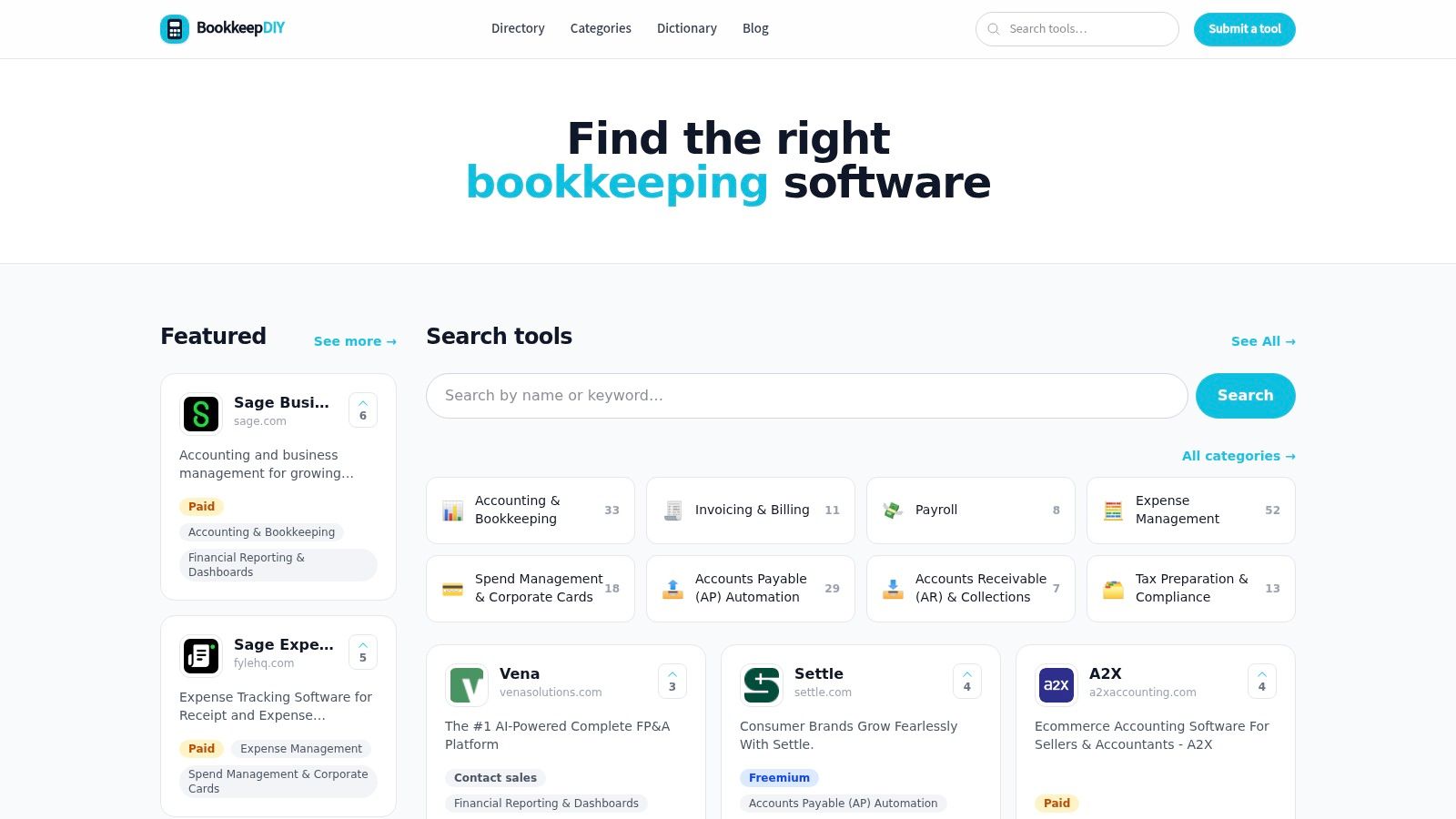
If you're exploring what that kind of setup looks like in practice, this AR software directory listing is a useful example of the type of category and feature overview to look for when comparing options.
At its best, software doesn't make your business colder. It keeps the lifeblood moving without forcing you to remember every reminder, every due date, and every unpaid balance on your own.
If you want a clearer way to learn bookkeeping terms and compare finance back-office tools without wading through vendor jargon, BookkeepDIY is a practical place to start. It's built for freelancers and small businesses that need plain-English guidance, curated software listings, and enough structure to choose tools with confidence.