
Alex just landed her first big client, opened the balance sheet, and felt the familiar jolt of confusion. Cash looked good, equipment had a value, there was a line for obligations she didn't fully recognize, and equity sat at the bottom like a final verdict she wasn't ready to interpret. That moment is common for freelancers and small business owners, because assets, liabilities, and equity are simple words that can feel abstract until real transactions start moving through the books.
The good news is that the balance sheet isn't trying to hide anything. It's showing a business's financial position at a single point in time, with everything arranged around one core idea, what the business owns, what it owes, and what belongs to the owner after obligations are accounted for, as the accounting equation in the balance sheet guide describes. Once those pieces click, decisions about spending, borrowing, and reinvesting get much easier.
Understanding the Key Concepts
A useful way to start is to treat these three terms like parts of a household checkup, not as accounting jargon. Assets are the resources a business controls and can use to create future benefit, liabilities are what the business owes, and equity is the residual claim left after obligations are deducted. In plain English, assets are the tools, liabilities are the bills, and equity is what's left for the owner after the dust settles.
A simple mental model
Think of a freelancer who runs a design studio from a laptop, a desk, and a stack of unpaid client invoices. The laptop and desk are assets because they support work, the unpaid invoice is also an asset because it represents money expected later, and a credit card balance used to buy software is a liability because it has to be repaid. The difference between the two sides becomes the owner's stake.
Practical rule: if the business controls it and it helps produce value, treat it as an asset. If the business must settle it later, treat it as a liability.
A lemonade stand makes the same logic easier to see. The pitcher, cups, and cash in the jar are assets, while money borrowed from a parent to buy supplies is a liability. Whatever remains after the borrowing is paid back is the owner's equity, even if it isn't sitting in cash.
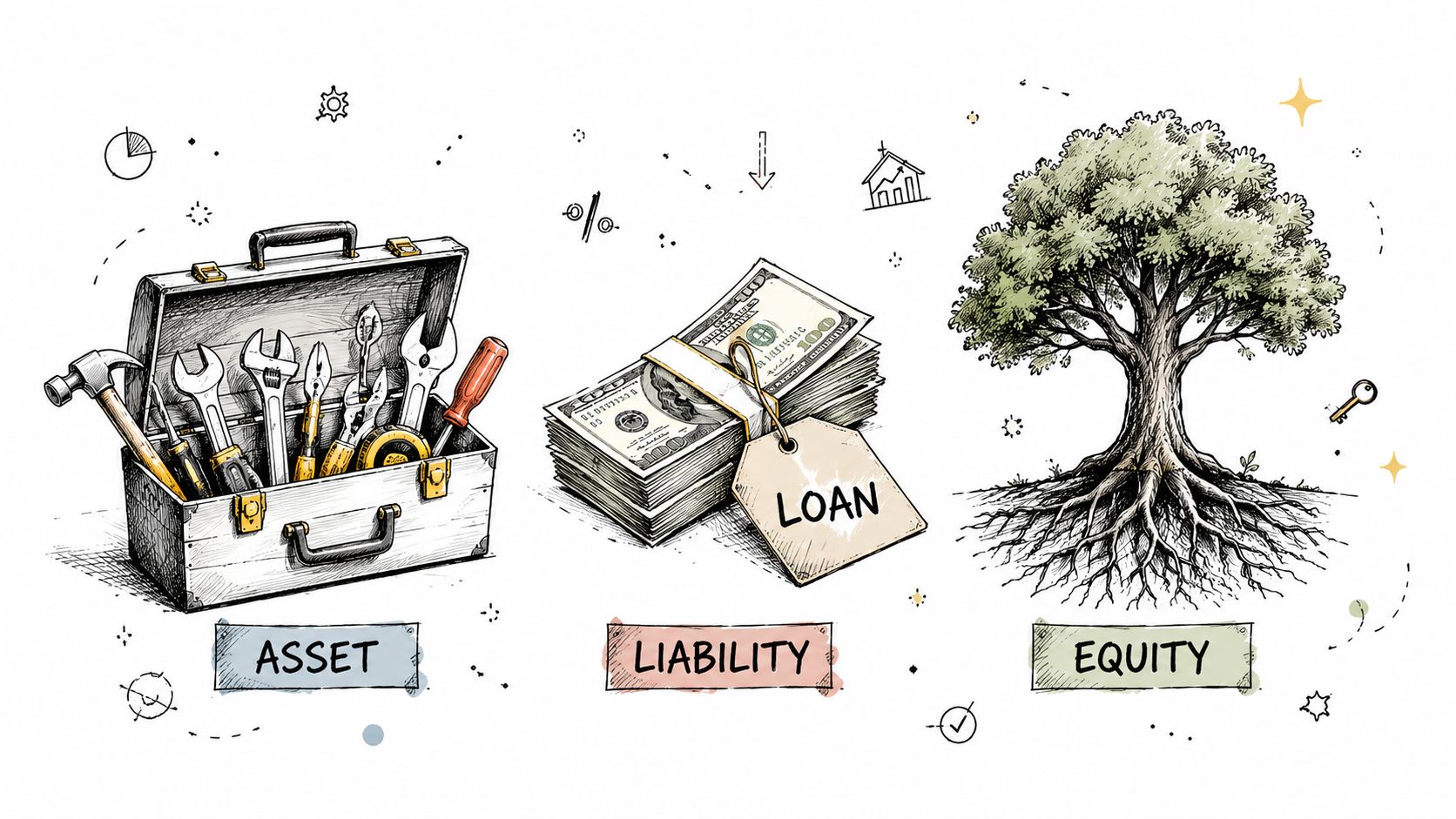
For a plain definition reference, the bookkeeping dictionary entry on assets is a helpful companion to this idea. The key is not memorizing the labels, but learning how each transaction changes the business's position. Once that pattern feels natural, the balance sheet stops feeling like a puzzle and starts feeling like a map.
Exploring the Accounting Equation
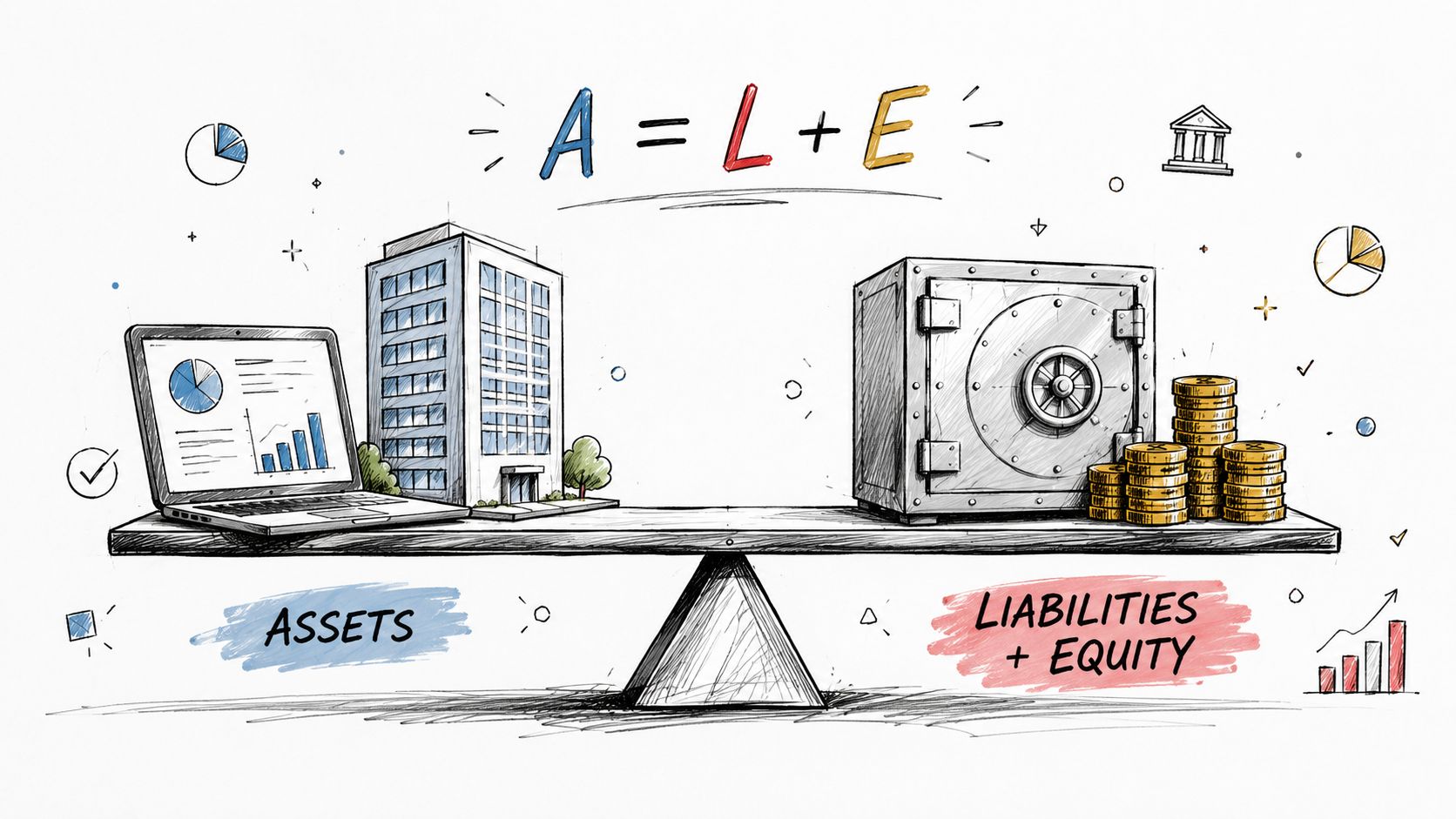
A balance sheet rests on a simple rule, Assets = Liabilities + Equity. The equation shows what a business controls, what it owes, and what belongs to the owner after debts are accounted for. The point is not only that the sides match. It is that every legitimate transaction must keep them in balance, as explained in the balance sheet overview.
Why the equation never breaks
A business cannot gain one side without affecting the other side in some way. If a freelancer buys a laptop with cash, one asset falls and another asset rises, so the total stays the same. If the laptop is bought with a loan, assets rise and liabilities rise by the same amount. If the owner adds personal money to the business, assets rise and equity rises at the same time.
When the equation looks off, the bookkeeping problem is usually classification, not math.
That is why the balance sheet matters beyond recordkeeping. It helps you assess liquidity, indebtedness, and capital structure at a glance, because the mix of assets, liabilities, and equity shows how much of the business is funded by obligations versus owner value. Analysts also use the reverse form, Equity = Assets − Liabilities, to see what remains after debts are settled.
A balance sheet is a snapshot, not a story
New bookkeepers often read the balance sheet like an income report. It does not show every event over a month, it shows one moment in time. That matters for freelancers and small businesses, because a busy week of sales can still sit beside unpaid bills, loan balances, or other obligations.
For a compact definition of how the statement works, the balance sheet dictionary page is a useful glossary reference. The main takeaway is simple. The equation checks the books and shows how much pressure liabilities place on the assets that remain. As claims against assets grow faster than the assets themselves, the financial picture becomes tighter.
Classification Examples for Freelancers and Small Businesses
The hardest part of bookkeeping is often not the formula, it's deciding where a transaction belongs. A designer, consultant, or shop owner may know that money moved, but not whether it changed an asset, a liability, or equity. That decision matters because the wrong classification can make the business look healthier or weaker than it really is.
| Transaction | Asset Impact | Liability Impact | Equity Impact |
|---|---|---|---|
| Buying office equipment with cash | One asset increases, another asset decreases | No change | No change |
| Taking a bank loan and receiving cash | Cash increases | Loan obligation increases | No change |
| Owner adds personal funds to the business | Cash increases | No change | Equity increases |
| Receiving a customer deposit before work is done | Cash increases | A future obligation may need to be recorded | No immediate change if it's tracked as a liability |
| Paying a business bill | Cash decreases | Liability decreases if the bill was already owed | No direct change |
| Collecting payment from a client on an invoice | Cash increases, receivable decreases | No change | No direct change |
Why these distinctions matter
A customer deposit can feel like income because cash arrived, but that doesn't mean the work is earned yet. A loan can feel like growth because cash increased, but the business also picked up a future repayment obligation. Owner funding is different again, because it raises both the business's resources and the owner's stake.
Use this test: ask whether the transaction creates something the business controls, something it owes, or a residual claim for the owner.
The easiest way to classify a transaction is to start with the destination of the value. If the business now controls a resource, ask whether a new obligation came with it. If no obligation came with it and the money came from the owner, equity probably moved. If the business received value but must deliver service later, the liability side deserves a closer look.
That habit helps freelancers especially, because their books often mix project income, deposits, reimbursements, and personal transfers. A clean classification turns those mixed signals into readable records. Once you can sort the transaction, the balance sheet becomes much easier to trust.
How Transactions Affect Your Balance Sheet
A freelancer gets paid, buys software, pays rent, and takes a small loan to cover slower months. Each move feels routine, yet each one changes the balance sheet by shifting cash, creating a claim, or adding an obligation. That is why the same transaction can look harmless in the moment but matter a great deal once the full picture is recorded.
Publicly listed U.S. companies report balance-sheet data under strict SEC rules. Negative equity happens when liabilities exceed assets, and that condition is treated as a warning sign in solvency analysis by lenders and regulators. The point is simple, if obligations keep growing faster than assets, the business has less room to absorb a setback.
Three common events
Taking a bank loan increases assets and liabilities at the same time. The business receives cash, but it also picks up a repayment obligation. Billing a client usually raises an asset, often accounts receivable, because the business now has a right to collect future cash. Paying monthly rent reduces cash and leaves less value in the business, which is why the timing of an expense changes how the statement looks later.
A useful way to read these changes is to ask what kind of claim the transaction creates. Some transactions bring in resources the business controls. Others create debts that must be paid later. Owner contributions are different again, because they increase the owner's stake in the business rather than creating a liability.
That mix matters for freelancers and small businesses, because everyday bookkeeping often blends project income, client deposits, reimbursements, personal transfers, and operating costs. A client deposit may feel like earned income, but if the work is still unfinished, part of that amount may belong on the liability side until the service is delivered. A loan may feel like growth, but the balance sheet shows the future repayment tied to it.
Negative equity is more than a textbook phrase. It means the business owes more than it owns, so the claims against the assets are larger than the assets available to cover them. Keeping track of that relationship helps you judge whether growth is being financed by earnings, by owner support, or by borrowing that adds pressure later.
Simple Journal Entry Illustrations
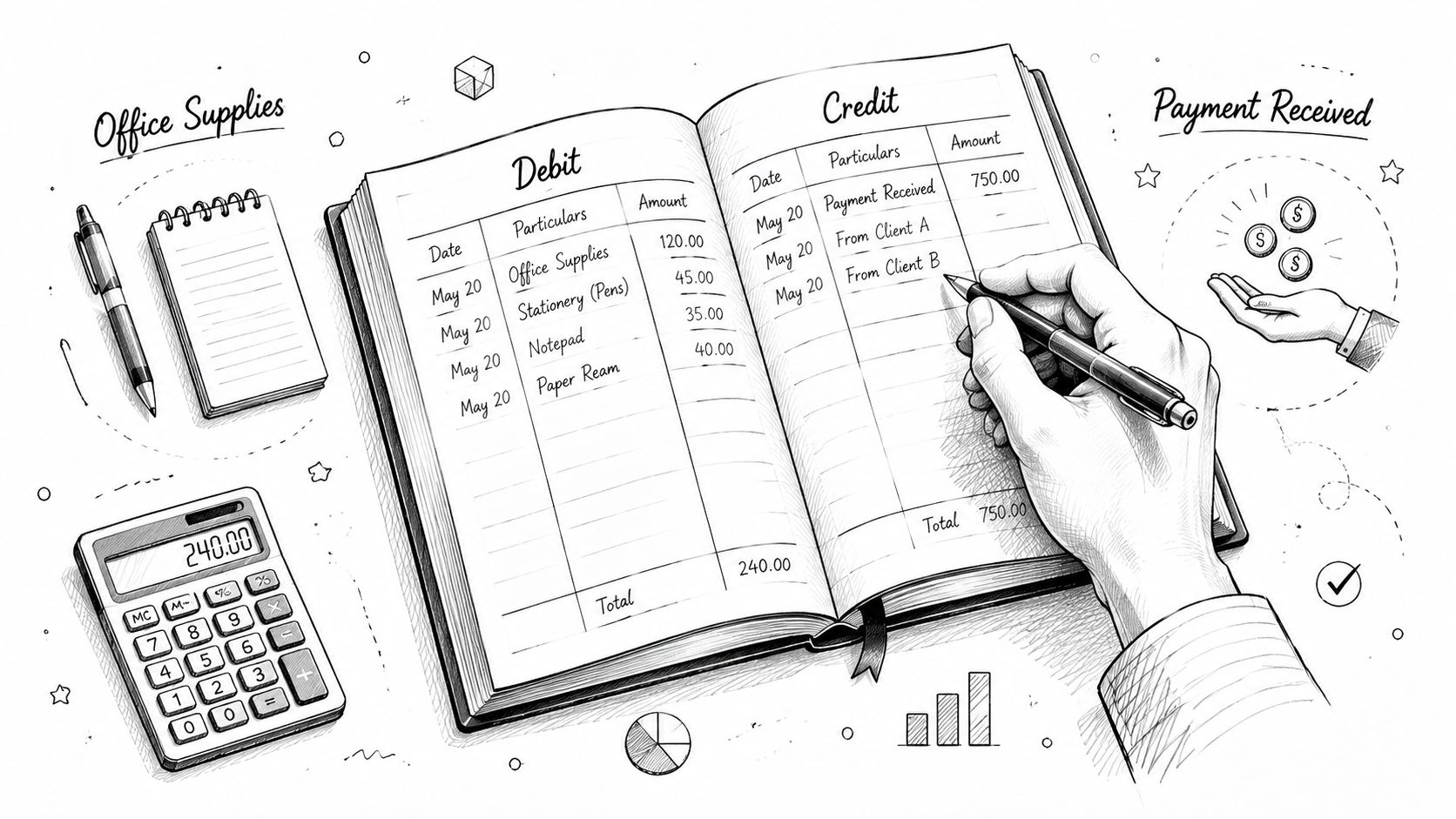
A freelance designer buys office supplies before a client deadline, then records the purchase so the books show what really happened, not just the cash leaving the account. Journal entries build the balance sheet line by line, and each entry keeps the equation in balance by recording at least two sides. Debit and credit language can feel technical at first, but it is just the bookkeeping way of showing where value moved and what claim changed.
Two basic patterns
A simple journal entry often follows one of two patterns. If a business receives payment on account, cash goes up and accounts receivable goes down. If a business pays a liability, cash goes down and the liability shrinks or disappears. In both cases, the entry does more than track movement, it shows that the business has changed the form of its value or reduced a claim against it.
A payment collected later can raise cash and increase retained earnings through income, while a forgiven obligation can improve equity by reducing what the business owes. Equity can grow without a fresh owner deposit because earnings may come from assets increasing or liabilities falling, which changes the owner's residual stake in the business. A drawing works the other way, because money taken for personal use reduces that stake.
For a plain-language explanation of how a journal entry is structured, see the journal entry dictionary page. A journal entry is the record that keeps the balance sheet honest, since each side of the entry shows how one account changed and why the equation still holds.
Practical Bookkeeping Tips and Common Mistakes
A freelancer sends an invoice and gets paid right away. A small business receives a client deposit before the work is finished. A contractor completes a job but has not billed for all of the labor yet. These everyday transactions can change equity in different ways, and the books only stay accurate when each one is classified by what it really is, not just by where the cash landed.
The biggest bookkeeping mistakes usually come from treating every inflow as income and every outflow as a simple expense. That shortcut breaks down fast when a business handles deferred revenue, accrued expenses, or other obligations that have not turned into cash yet. Under international accounting standards, a liability is a present obligation expected to cause an outflow of resources. That is why items like deferred revenue and accrued expenses can cloud equity if they are not classified correctly.
Where confusion usually starts
A freelancer may receive payment before completing the work and assume the money is fully earned. A small business may owe for services already received and forget to record the obligation because cash has not left yet. In both cases, the books can make equity look healthier than it really is if the liability side is not updated.
A client deposit is a good example. The cash arrives, but the business still owes the service or product, so that amount is not true profit yet. Accrued expenses work in the same direction, because the bill may not be paid today, but the obligation already exists. If both are booked as ordinary income or ignored entirely, equity becomes distorted.
Bookkeeping software can help or hurt here. If the system only follows cash movement, it can miss obligations that are very real even though they are not paid yet. Equity can then appear stronger than it is when commitments sit off-book or are classified loosely.
A few habits keep the records cleaner:
- Match timing to reality. Record revenue when it is earned and obligations when they exist, not only when cash moves.
- Separate owner money from business money. Personal withdrawals are not ordinary expenses, and owner contributions are not sales.
- Watch non-cash obligations closely. Deferred revenue and accrued expenses can change what the business owes.
- Recheck balances after big events. Loans, deposits, equipment purchases, and unpaid bills deserve a second look.
The most reliable books treat equity as the result of real business activity, not as a leftover number at the bottom of the page. Once you check classification at the moment a transaction happens, the balance sheet becomes much easier to read. That habit reduces false confidence and makes planning ahead much clearer.
Conclusion and Next Steps
Assets, liabilities, and equity are easier to understand when you stop treating them as abstract labels and start tracing everyday transactions through the books. A purchase, a loan, a deposit, or an owner transfer all change the picture in different ways, and the balance sheet only makes sense when those changes are classified well. Once that clicks, you can read financial position with far more confidence.
If you're ready to put this into practice, review your last few transactions and ask which ones created assets, which ones created obligations, and which ones changed equity. Then choose bookkeeping tools and workflows that track liabilities and equity clearly, not just cash. A careful setup now saves confusion later.
A CTA for BookkeepDIY.