
You send an invoice, the client pays in full, and your bank balance jumps overnight. For a moment, it feels like you've had a great month.
Then your books tell a more complicated story.
If that payment covers work you haven't done yet, you can't treat all of it as income right away. Part of that cash belongs to future months because the customer paid in advance for future value. That timing gap is where many small business owners get tripped up. The money is in the bank, but it isn't fully earned.
That's why deferred revenue accounting matters. Yes, it keeps you compliant. But it also gives you something just as useful: a more honest view of what cash is available now, what revenue is locked in for later, and how much work you still owe customers.
Why Getting Paid Upfront Complicates Your Books
A lot of small businesses run into deferred revenue without realizing it. A designer collects a project deposit. A consultant bills a retainer at the start of the month. A service business sells a prepaid package. A subscription business charges customers before the service period begins.
In each case, the cash arrives first. The work happens later.
That creates a bookkeeping problem. If you book the full payment as revenue the day it lands, your income statement can look stronger than reality. You may think you had a big month when, in truth, you've also taken on a future obligation. You still owe service, access, support, delivery, or time.
Why this feels confusing
Most owners think in cash terms first. That's normal. You see money hit the account and your brain says, “We earned it.”
Accounting asks a different question: Have you delivered what the customer paid for yet?
If the answer is no, or only partly, then some or all of that payment sits in deferred revenue until you earn it. That's the simple idea.
You can have cash in hand and still owe the customer something. Deferred revenue is the bookkeeping reminder of that promise.
This isn't just a technical issue for larger companies. A 2025 discussion of deferred revenue trends notes that 78% of small business finance leaders report they can't confidently translate deferred revenue trends into cash flow forecasts. That matters because owners make real decisions from those numbers: hiring, spending, pricing, and how much cushion they think they have.
Why it matters beyond compliance
When you separate cash received from revenue earned, your books become more useful.
- You see your obligations clearly: Deferred revenue shows what customers already paid for but you still need to deliver.
- You forecast better: You can tell the difference between fresh sales cash and cash tied to future work.
- You avoid false confidence: A strong bank balance can hide a heavy workload already promised.
If you collect customer payments through card billing, it also helps to understand the flow of money before it reaches your books. A practical starting point is this guide to Stripe bookkeeping workflows.
Understanding Deferred Revenue and Why It Matters
A customer prepays for six months of service on January 1. Your bank balance goes up that day, which feels like a sale. But your books have to answer a different question. How much of that payment have you earned so far?
Deferred revenue is money you've already collected for work, access, or delivery that will happen later. In bookkeeping terms, it starts life as a liability because your business still owes the customer something.
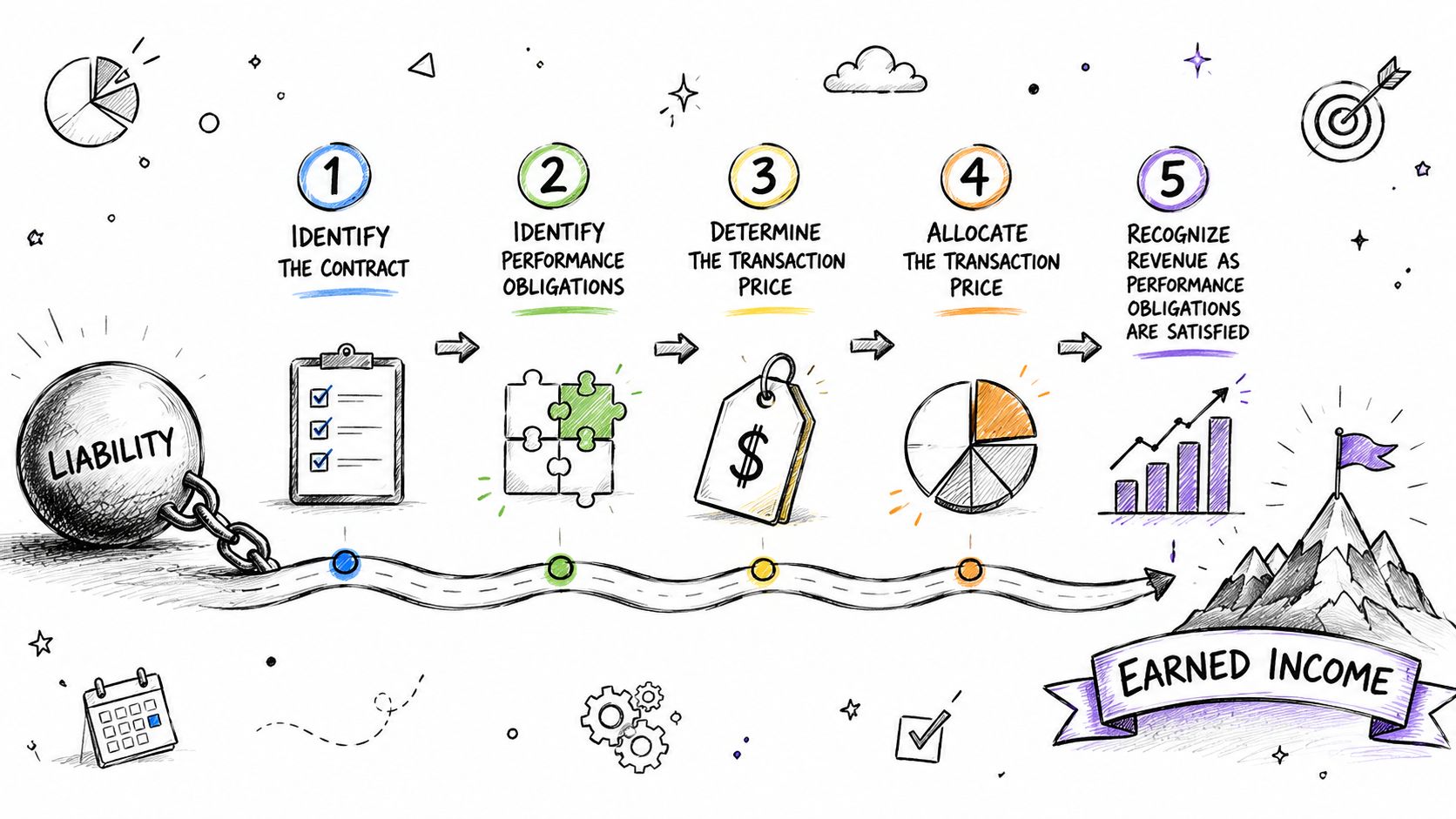
A concert ticket makes the idea easier to see. The organizer receives the money today, but still owes the customer a seat at next month's event. Until the concert happens, that cash is tied to a promise.
The same logic shows up in everyday small business transactions:
- A gym collects membership fees before the month of access begins.
- A consultant receives a retainer before completing the project work.
- A software business charges upfront for future access.
- A coach sells a package before all sessions are delivered.
In each case, the customer has paid, but the business has not fully earned the revenue yet.
Core concept: Deferred revenue is cash connected to unfinished obligations.
Why it appears on the balance sheet
The balance sheet is not just a list of what you own. It also shows what you still owe. Deferred revenue belongs there because it represents services, products, or access you have promised but not yet delivered.
As you do the work, that liability shrinks and revenue increases. Month by month, your books begin to match the accurate progress of the job.
That matters for compliance, but it also matters for planning. If you treat every upfront payment as fully earned income, your profit can look stronger than it really is. You may hire too soon, spend too freely, or assume future months are better funded than they are. When deferred revenue is tracked correctly, cash flow forecasting gets sharper because you can separate cash already in the bank from revenue you still have to earn.
Deferred revenue compared with accounts receivable and accrued revenue
These three terms get mixed up because they all deal with timing. The easiest way to sort them out is to ask two questions: Has the cash arrived? Has the work been earned?
| Term | What it means | Cash status |
|---|---|---|
| Deferred revenue | Customer paid before you earned the revenue | Cash already received |
| Accounts receivable | You earned the revenue and billed the customer | Cash not yet received |
| Accrued revenue | You earned the revenue but haven't billed or collected yet | Cash not yet received |
A simple memory aid helps. Deferred revenue means paid first, earned later.
That distinction does more than clean up your bookkeeping. It helps you read your business with better judgment. A large cash balance can mean strong demand, but it can also mean you have a lot of future work already spoken for.
When Can You Recognize Your Deferred Revenue
You recognize deferred revenue when you've done what you promised. Not when the invoice is sent. Not when the payment clears. Not when you feel the sale is secure.
You recognize it when the customer has received the good or service you were obligated to deliver.
Under ASC 606 and IFRS 15, revenue is recognized only when a performance obligation is satisfied through a five-step framework. Those formal rules sound dense, but the logic is straightforward when you put them into plain English.
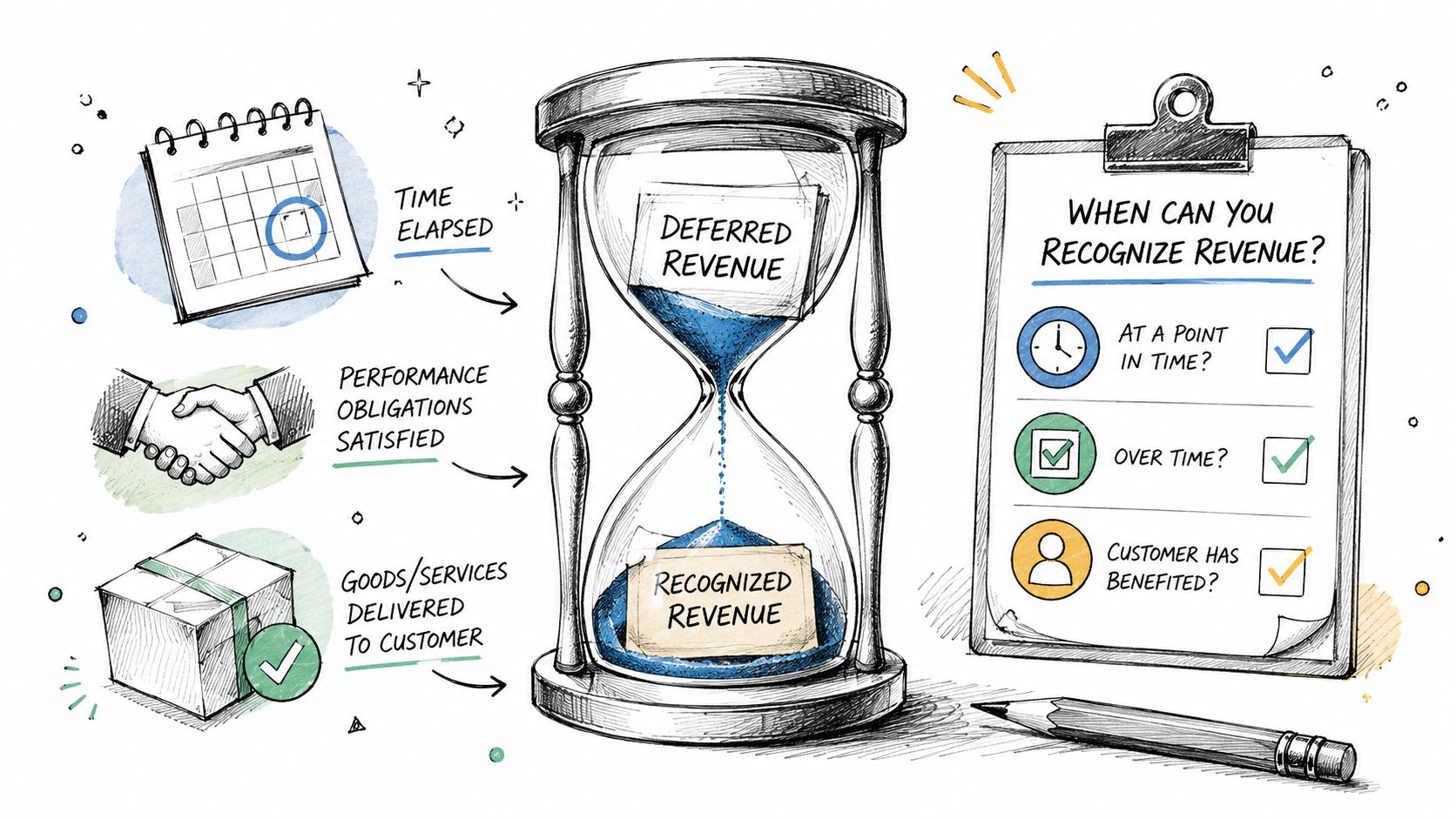
Five plain-English questions to ask
What's the agreement
Start with the actual deal. What did the customer buy, and what did you agree to provide?
This could be a written contract, an accepted proposal, a prepaid service package, or an online subscription purchase. If the agreement is vague, the accounting gets vague too.
What exactly did you promise
Many owners often oversimplify this aspect.
If you sold one thing, the answer is easy. If you sold a bundle, you may have promised more than one deliverable. For example, access plus setup, or a product plus follow-on service. Each promised item may need its own timing for recognition.
What's the total price
Next, confirm the full amount the customer is paying under the agreement.
That sounds obvious, but discounts, credits, bundled pricing, and changes to scope can muddy the total. You want one clear number before deciding how much gets recognized and when.
If there's more than one promise, what is each part worth
A bundled agreement often creates the biggest confusion in deferred revenue accounting.
If a customer pays one total amount for several distinct deliverables, you can't just recognize revenue however you like. You need a reasonable way to allocate the total price to each part of the deal.
For a small business owner, the practical takeaway is simple: don't assume every prepaid contract should be recognized in one smooth line if the work isn't delivered in one smooth line.
If you sell setup now and support later, the timing of revenue should follow the timing of delivery.
When does the customer actually receive control or benefit
This is the final test.
For a physical product, that may be when the customer receives it. For a service over time, it may be monthly as access or support is provided. For milestone work, it may be when each milestone is completed.
A few common patterns make this easier:
- Monthly access businesses: Recognize revenue month by month as access is provided.
- One-time future events: Recognize when the event occurs.
- Project work with stages: Recognize as each committed stage is completed.
- Prepaid service blocks: Recognize as each session, period, or unit of service is delivered.
A useful rule for owners
If you had to refund the customer because you haven't delivered yet, that unpaid promise is a clue the amount likely still belongs in deferred revenue.
That's not a legal test. It's a practical bookkeeping mindset. It keeps you focused on delivery, not just payment.
Deferred Revenue Accounting Examples and Journal Entries
A real example makes this easier.
Say a customer pays you in January for work you will deliver from February through July. Your bank balance goes up right away, but your income does not. In your books, that prepaid amount starts life as a liability because you still owe the customer something.
The entries follow a simple pattern. First, record the cash you received and the obligation you now owe. Then, as you deliver the product or service, move the earned portion out of deferred revenue and into income.
If the mechanics still feel unfamiliar, this plain-English guide to a journal entry can help before you build your monthly schedule.
Example one, a prepaid service contract
A customer pays $500 upfront for six months of consulting services.
When the cash comes in, you have not earned any of it yet. The opening entry is:
| Account | Debit | Credit |
|---|---|---|
| Cash | $500 | |
| Unearned Revenue | $500 |
Now the work begins. If you deliver the service evenly over six months, you recognize $83.33 each month:
| Account | Debit | Credit |
|---|---|---|
| Unearned Revenue | $83.33 | |
| Revenue | $83.33 |
A gym membership works the same way. The customer may pay for six months on day one, but you earn it month by month as access is provided.
By the end of month six, the deferred revenue balance is zero. Every dollar has been earned and moved into revenue.
Example two, an annual software subscription
Now use the same logic for a subscription.
A customer prepays for a full year of access. You still do not earn the full amount on the day payment arrives, because the service period stretches across future months. Your first entry records cash received and deferred revenue:
| Account | Debit | Credit |
|---|---|---|
| Cash | amount received | |
| Deferred Revenue | amount received |
Then, at each month-end, recognize the piece you earned during that month:
| Account | Debit | Credit |
|---|---|---|
| Deferred Revenue | monthly earned portion | |
| Revenue | monthly earned portion |
This example matters for more than clean bookkeeping. If you can see how much of that annual prepayment is still unearned, you can also make better cash flow forecasts. You know you already have cash in hand, but you also know how much service you still need to deliver in future months.
Example three, a project deposit
Deposits often confuse owners because the payment feels like a sale.
Say you collect a deposit before starting a custom project. Until you complete the agreed work tied to that deposit, the amount usually stays in deferred revenue. The opening entry looks like this:
| Account | Debit | Credit |
|---|---|---|
| Cash | deposit amount | |
| Deferred Revenue | deposit amount |
Later, when you complete the stage of work covered by that deposit, recognize the amount you have earned:
| Account | Debit | Credit |
|---|---|---|
| Deferred Revenue | earned portion | |
| Revenue | earned portion |
A concert ticket is a useful comparison. The customer may pay weeks early, but the organizer has not earned that money until the event takes place.
A month-by-month view
Here is a simple schedule for a prepaid subscription. This kind of schedule helps you do two jobs at once. It keeps revenue recognition accurate, and it shows how much paid work is still sitting in your pipeline.
| Month | Journal Entry | Recognized Revenue (This Month) | Deferred Revenue Balance |
|---|---|---|---|
| Month 1 | Debit Deferred Revenue, Credit Revenue | $100 | $500 |
| Month 2 | Debit Deferred Revenue, Credit Revenue | $100 | $400 |
| Month 3 | Debit Deferred Revenue, Credit Revenue | $100 | $300 |
| Month 4 | Debit Deferred Revenue, Credit Revenue | $100 | $200 |
| Month 5 | Debit Deferred Revenue, Credit Revenue | $100 | $100 |
| Month 6 | Debit Deferred Revenue, Credit Revenue | $100 | $0 |
The table title is 6-Month Subscription Revenue Recognition Example ($600 Paid Upfront).
What these examples teach
The journal entries are the mechanics. The business lesson is broader.
- Cash and revenue happen on different timelines: Payment may arrive now, while revenue is earned later.
- Deferred revenue shrinks as you deliver: Each recognition entry reduces what you still owe the customer.
- A schedule gives you visibility: You can see what has been earned, what remains unearned, and how that affects future reporting and planning.
A good deferred revenue schedule does more than keep your books compliant. It also helps you forecast with more confidence, because you can separate cash already collected from revenue you will recognize later as work is completed.
How to Reconcile and Report Deferred Revenue
Recording deferred revenue is only half the job. You also need to reconcile it.
Reconciliation means proving that the deferred revenue balance on your books matches the customer obligations you still owe. This matters at month-end because a stale balance can misstate both your liabilities and your revenue.
A deferred revenue reconciliation framework from Numeric describes this as a high-scrutiny month-end process that follows a precise sequence of opening balance, plus new receipts, minus recognized revenue, to arrive at the ending balance tied to the general ledger.
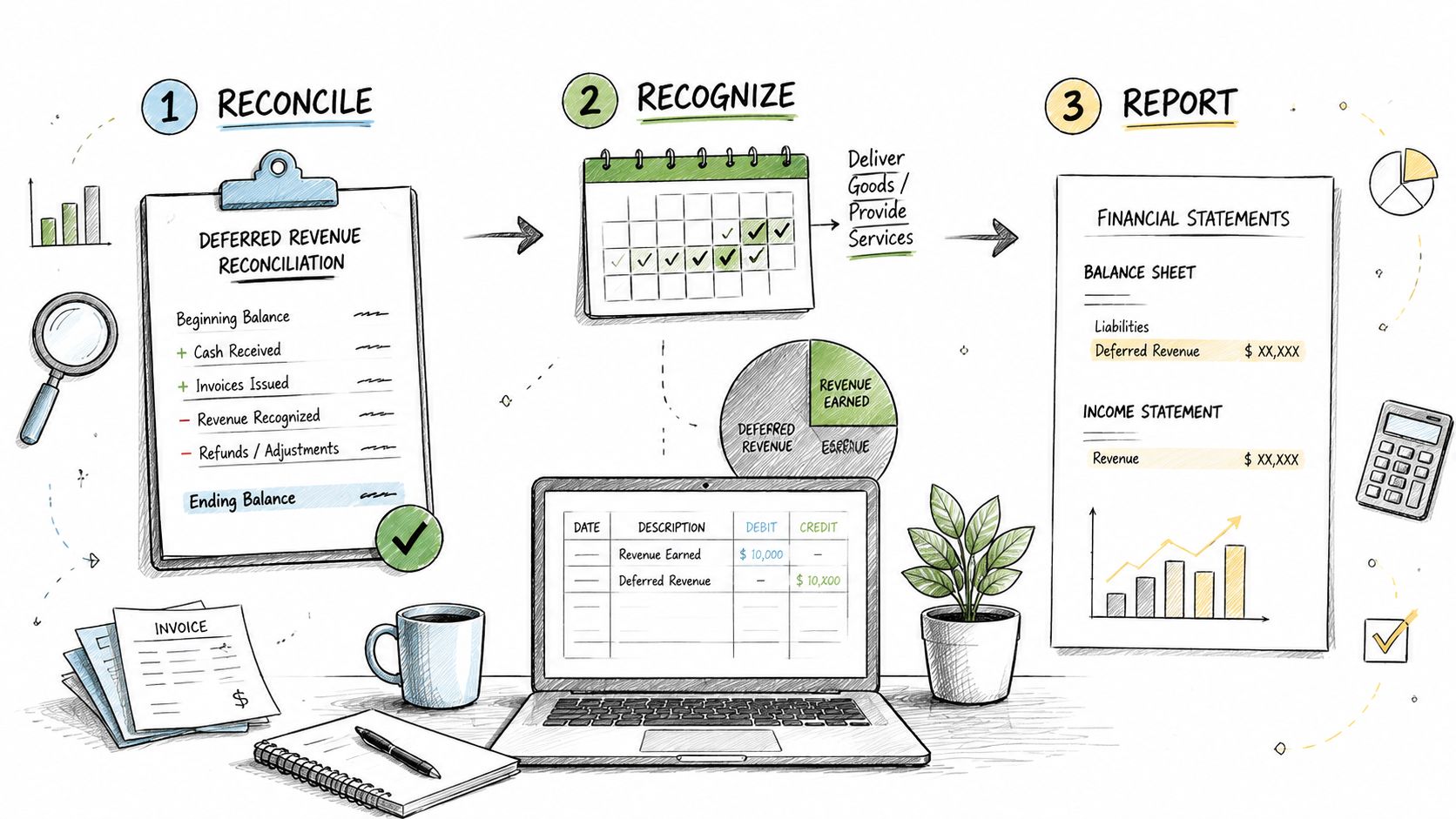
The simple formula
Use this basic check each month:
**Opening deferred revenue
- New customer prepayments
- Revenue recognized = Closing deferred revenue**
That formula sounds small, but it catches a lot of errors.
If your ending balance doesn't match your schedule, something is off. Maybe a payment was posted straight to revenue. Maybe a monthly recognition entry was missed. Maybe a cancellation or refund wasn't applied properly.
What a clean reconciliation process looks like
A practical month-end routine usually includes these steps:
- Pull the opening balance: Start with last month's ending deferred revenue.
- Add new upfront payments: Include all cash collected for future work.
- Subtract earned amounts: Post the revenue you recognized during the month.
- Adjust for changes: Reflect refunds, cancellations, or contract changes.
- Tie the ending balance out: Make sure the balance agrees with your ledger and your detail schedule.
If you already have a monthly close checklist, this step belongs right alongside bank and payment account checks. This guide to bank feeds reconciliation is useful if you're tightening your overall close process.
Clean reconciliation turns deferred revenue from a confusing liability into a reliable planning number.
Where deferred revenue shows up in your reports
On the balance sheet, deferred revenue appears as a liability because you still owe future goods or services.
On the income statement, the recognized portion appears as revenue as you earn it. That smooths income across the period in which you deliver value, instead of spiking revenue when cash first arrives.
The cash flow view tells a different story. Cash may arrive upfront even while revenue is recognized gradually. That's exactly why deferred revenue matters for forecasting. It helps you separate money collected from money earned.
Why this helps with cash flow forecasting
Small business owners often look at the bank balance and assume they have room to spend. Deferred revenue adds a useful pause.
If a large share of your cash came from prepayments for future work, some of that bank balance is already committed operationally. You may need that cash to cover labor, support, materials, or time tied to those customer obligations.
When your deferred revenue schedule is current, you can ask smarter planning questions:
- Which future months already have revenue partly locked in?
- How much work is already sold but not yet delivered?
- How much incoming cash reflects new sales versus old commitments?
That's the strategic side of deferred revenue accounting. It keeps you compliant, but it also sharpens your decisions.
Avoiding Common Deferred Revenue Mistakes
Most deferred revenue problems aren't caused by complicated rules. They happen because busy owners use shortcuts.
A few habits can prevent most of the damage.
What not to do and what to do instead
Don't book every upfront payment as revenue: Do create a dedicated deferred revenue liability account and post prepayments there first.
Don't rely on memory for monthly recognition: Do keep a schedule with contract start dates, end dates, billing amounts, and how much should move into revenue each period.
Don't ignore partial delivery: Do recognize revenue in line with what you've actually delivered. If service happens over time, recognition should usually happen over time too.
Don't leave refunds and cancellations out of the schedule: Do update deferred revenue when the customer relationship changes. An old liability balance can linger long after the real obligation changed.
Don't mix deposits with earned income: Do ask a simple question when cash arrives: “Have we earned this yet?” If not, it likely belongs in deferred revenue.
Practical habits that help
Some businesses handle this with accounting software setup. Others use a spreadsheet schedule and manual entries. Either can work if the process is consistent.
Good habits include:
- Use a separate liability account: This keeps deferred revenue visible instead of buried in sales.
- Set recurring reminders: Monthly recognition entries are easy to forget during busy seasons.
- Review contracts before posting cash: The contract tells you when value is delivered.
- Keep notes on unusual deals: Bundles, milestone work, and scope changes need extra attention.
Small bookkeeping errors around deferred revenue don't stay small for long. They affect profit, liabilities, and planning at the same time.
If you're a one-person business, don't aim for perfection on day one. Aim for a repeatable system. A basic schedule maintained every month is far better than guessing at year-end.
Deferred Revenue Accounting FAQs
Is deferred revenue the same as a customer deposit
Not always.
A customer deposit is a broad business term for money paid in advance. In accounting, that amount often ends up in deferred revenue if it relates to future goods or services you still owe. The deciding factor is the obligation behind the payment.
Where should I put deferred revenue in my chart of accounts
For most small businesses, deferred revenue is usually set up as a liability account on the balance sheet. If the obligation will be satisfied within the normal operating cycle or within a year, it's commonly treated as a current liability.
What if I do some of the work now and some later
Then only the earned portion should move into revenue now. The remaining amount stays in deferred revenue until you complete the rest.
This is common with retainers, prepaid service packages, memberships, and staged project work.
Is deferred revenue good or bad
By itself, it's neither.
It can be a healthy sign because it means customers paid you before full delivery. But it also means you owe future work. The number only becomes useful when you read it alongside your workload, staffing, service commitments, and cash needs.
How does this work in bookkeeping software
The general approach is simple. Create a liability account for deferred revenue, post prepayments there when cash is received, and then move earned amounts into revenue with recurring or manual journal entries.
The exact clicks vary by system, but the bookkeeping logic stays the same.
What about taxes
Tax treatment can differ from financial statement treatment. One verified reference notes that deferred revenue can be taxable upon cash receipt under tax law even though GAAP treats it as a liability until earned. That's why it's smart to ask a tax professional how your filing method applies to your situation.
What's the easiest way to stay accurate
Keep a current deferred revenue schedule.
If you know who prepaid, what period the payment covers, how much has been earned, and how much remains unearned, most of the confusion disappears.
If you want clearer bookkeeping without drowning in accounting jargon, BookkeepDIY is a practical place to start. It offers plain-English explanations, a bookkeeping dictionary for confusing terms, and curated software guidance for freelancers and small businesses that want to understand the numbers before choosing tools.