


Mixing personal and business finances is one of the most common mistakes small business owners make. It starts innocently enough: you grab lunch with a client and pay with your personal card, or you buy office supplies while doing your grocery run. Before long, your bank statements look like a puzzle, and tax season becomes a nightmare.
The good news is that separating your finances does not have to create more work. With the right setup, it actually makes bookkeeping faster and less stressful.
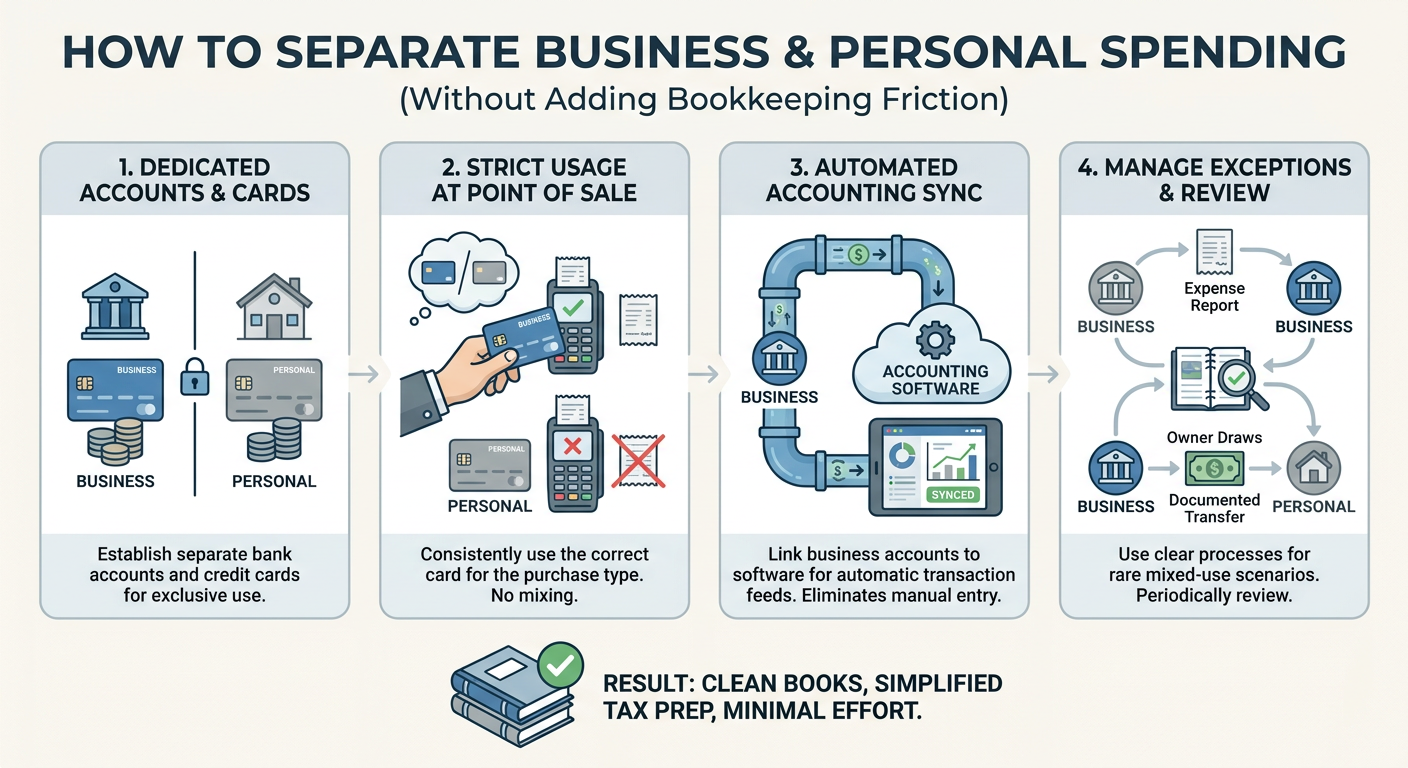
This article walks you through practical steps to keep your business and personal spending cleanly separated, without adding hours to your accounting routine.
Key Takeaways
- Open a dedicated business bank account and credit card as soon as possible
- Set a clear rule: business expenses go on business accounts, personal expenses go on personal accounts, no exceptions
- Use accounting software that connects directly to your business accounts
- Pay yourself a regular salary or owner's draw instead of pulling money randomly
- Keep receipts and notes for any edge cases, like mixed-use expenses
Why Mixing Business and Personal Finances Causes Problems
The consequences of blurred finances go beyond messy spreadsheets.
- Tax complications: The IRS expects clear records. Mixed accounts make it hard to prove which expenses are legitimate deductions.
- Legal exposure: If you operate as an LLC or corporation, mixing funds can pierce the corporate veil, meaning creditors could come after your personal assets.
- Cash flow confusion: You cannot accurately measure business profitability if personal spending is tangled in your numbers.
- Audit risk: Disorganized records increase your chances of triggering an audit and make it harder to respond if one happens.
Separation is not just about tidiness. It protects your business and your personal finances.
Step 1: Open a Dedicated Business Bank Account
This is the single most important step. A business checking account creates a clear boundary between your two financial worlds.
What to look for in a business bank account:
- No or low monthly fees
- Free ACH transfers
- Integration with accounting software like QuickBooks or Wave
- A debit card for everyday business purchases
Many online banks, such as Relay, Mercury, or Bluevine, offer business accounts with no minimum balance requirements. Traditional banks work too, but compare fees carefully.
Once your account is open, route all business income into it and pay all business expenses from it. That single habit eliminates most of the confusion.
Step 2: Get a Dedicated Business Credit Card
A business credit card adds another layer of separation and comes with real benefits.
- Earns rewards on business spending
- Builds business credit history
- Provides a clear monthly statement of business expenses
- Offers purchase protections useful for business equipment
Use this card exclusively for business purchases. Leave your personal card in your wallet when you are buying anything for the business.
If you are just starting out and do not yet qualify for a business credit card, a dedicated personal card used only for business can work as a temporary solution. Just be consistent about it.
Step 3: Pay Yourself a Regular Salary or Owner's Draw
One of the biggest sources of financial mixing is pulling money from the business account whenever you need personal cash. This creates random transactions that are hard to categorize and track.
Instead, set a schedule. Whether it is weekly, biweekly, or monthly, transfer a set amount from your business account to your personal account on a regular basis. This becomes your salary or owner's draw.
Benefits of a regular payment schedule:
- Your business account reflects actual business cash flow
- Your personal account has predictable income
- Bookkeeping entries are simple and consistent
- It is easier to budget personally when your income is predictable
If your business income is irregular, you can still set a minimum draw and adjust quarterly based on profitability.
Step 4: Choose Accounting Software That Connects to Your Accounts
Manual data entry is where bookkeeping gets painful. Modern accounting software eliminates most of it by syncing directly with your bank and credit card accounts.
When transactions import automatically, you only need to review and categorize them, not type them in. This takes minutes instead of hours.
Popular options for small business owners:
| Software | Best For | Starting Price |
|---|---|---|
| QuickBooks Online | Growing businesses with complex needs | ~$30/month |
| Wave | Freelancers and very small businesses | Free (paid add-ons) |
| [FreshBooks](http://us-freshbooks.com/) | Service-based businesses and invoicing | ~$19/month |
| [Xero](https://www.xero.com/us/) | Businesses needing strong reporting | ~$15/month |
Connect your business bank account and business credit card to whichever platform you choose. Do not connect personal accounts. Keeping the software focused on business-only accounts keeps your books clean from the start.
Step 5: Handle Edge Cases With a Simple System
Even with the best intentions, edge cases happen. You forget your business card and pay for a client dinner with your personal card. You buy a laptop you use for both work and personal projects.
These situations do not have to derail your bookkeeping. You just need a simple process for handling them.
For personal card used on a business expense:
1. Note the amount and what it was for
2. Reimburse yourself from the business account
3. Categorize the reimbursement as a business expense in your accounting software
For mixed-use expenses (like a phone or car):
1. Determine the percentage used for business (for example, 70% business, 30% personal)
2. Deduct only the business portion
3. Keep a log or note in your records to support the split
The key is documentation. A quick note in your accounting software or a photo of the receipt with a label goes a long way if questions come up later.
Step 6: Do a Monthly Bookkeeping Review
Separation is easier to maintain when you check in regularly. A monthly review does not need to take long, but it catches problems before they pile up.
Your monthly checklist:
- Review all imported transactions and confirm categories
- Flag any personal charges that accidentally hit the business account
- Reconcile your bank and credit card statements
- Check that your owner's draw was recorded correctly
- Note any mixed-use expenses and document the split
Thirty minutes once a month is far better than ten hours of untangling at tax time.
Common Mistakes to Avoid
Even business owners who try to stay organized fall into these traps.
- Using the business account for personal emergencies: This feels harmless in the moment but creates messy records. Keep a personal emergency fund instead.
- Letting receipts pile up: Small purchases add up and become hard to remember. Snap a photo immediately using your accounting app.
- Skipping the monthly review: Transactions that seem obvious now will be confusing in six months.
- Not having a written policy: If you have employees or contractors, document what gets reimbursed and how. Verbal agreements lead to inconsistency.
Conclusion
Separating business and personal spending is one of the highest-leverage habits you can build as a business owner. It protects you legally, simplifies your taxes, and gives you a clear picture of how your business is actually performing.
The setup takes a few hours upfront. After that, the ongoing maintenance is minimal, especially if you use accounting software that syncs automatically.
Your next steps:
1. Open a business bank account this week if you do not already have one
2. Apply for a business credit card or designate a card exclusively for business use
3. Set up accounting software and connect your business accounts
4. Schedule a recurring monthly bookkeeping review on your calendar
5. Establish a regular owner's draw schedule
Start with step one. The rest follows naturally.