
The last week of the month has a way of exposing every loose end at once. Bank statements still need reconciling, payroll still needs a clean test, and a half-finished software migration suddenly matters because someone needs numbers for the close tomorrow. In that moment, the problem usually isn't effort. It's that the work was never broken into project management tasks with one owner, one deadline, and a clear order of operations.

That's why finance work falls apart in predictable ways. Bookkeeping, payroll, compliance, and system changes all depend on the same thing, which is disciplined task orchestration. If you want a practical checklist view for the month-end side of this work, the right starting point is a financial month-end close checklist, not a bigger pile of reminders.
You'll leave with a phase-by-phase map, three finance-specific task examples, a rule for what gets cut first when bandwidth collapses, and the quiet failure points that break close, payroll, and migration work even in competent teams. This is not a software roundup. It's a working playbook for organizing the work itself.
The Moment a Finance Project Slips
The first sign of trouble is usually boring. A business owner looks at the calendar on the 28th, realizes the bank feed is still off, the new payroll provider hasn't been tested, and the accounting migration is half-done because “someone was on it.” Nothing dramatic happened. The work just lived in too many places, with too many assumptions and no hard task boundaries.
Why chaos usually means missing task structure
A project doesn't fail because the team lacked care. It fails because no one turned the goal into named tasks, each with a deadline and a handoff point. In finance operations, that's especially dangerous because one missed step can spill into the next cycle. A reconciliation that slips this week can distort the numbers the next week. An untested payroll setup can turn into a missed payday. A migration without a finish line can leave two systems partially trusted and both of them wrong.
The fix starts with language. Stop calling the whole effort “close,” “migration,” or “payroll setup” as if that's a task. Those are projects. The tasks are the individual units inside them, the ones a person can finish, mark complete, and hand off without ambiguity.
Practical rule: if a step can't be assigned to one person, dated, and checked off, it's not a task yet.
For small businesses, this matters even more because finance work competes with client delivery, sales, and support. That's where a light but firm structure helps. A simple task board, a spreadsheet, or a checklist system can be enough if it captures ownership and sequence. The point is not ceremony. The point is reducing the number of places where work can go missing.
What Counts as a Project Management Task
A project management task is a discrete piece of work with a clear output, a single accountable owner, a deadline, and, when needed, a dependency note. That definition sounds obvious until you look at how small teams operate. Work often lives in a Slack thread, a shared inbox, or one person's memory, which means the system has no stable record of who owes what to whom.
The difference between a task and a loose to-do
A loose to-do says “review the close.” A real task says “reconcile the operating bank account and attach unresolved items for review by Wednesday at noon.” One can be done. The other can be interpreted forever. For bookkeeping and finance workflows, that distinction matters because the work compounds. A missed reconciliation doesn't stay local. It affects reporting. An untested payroll change doesn't stay theoretical. It affects cash and trust.
That's also why the labor market treats coordination as a serious skill. The U.S. Bureau of Labor Statistics says project management specialists coordinate the budget, schedule, staffing, and other details of a project, and the occupation is projected to grow 6% from 2024 to 2034, with about 78,200 openings per year on average over the decade, while the median annual pay was $100,750 in May 2024 (BLS occupational outlook for project management specialists). That isn't administrative trivia. It's proof that task orchestration has become a core business capability.
The minimum fields every task should carry
A solid task record doesn't need to be fancy, but it does need to be complete:
- Owner: one person who is responsible for completion.
- Output: the finished artifact, decision, or checkpoint.
- Due date: the moment the work must be done, not “ASAP.”
- Dependency: anything that must happen first.
That structure stops the common small-team failure where everyone thinks someone else is on it. It also makes handoffs cleaner, which matters in finance because the next step often depends on the last one being accurate. When the task is defined well, the work becomes visible enough to manage instead of just discuss.
The Five Phases and the Tasks Inside Each
The classic phase model still works because it forces the work into a sequence. For small-business finance projects, the useful phases are initiation, planning, execution, monitoring, and closure. The value isn't in the labels. It's in knowing which task belongs where, and which ones repeat across the whole lifecycle.
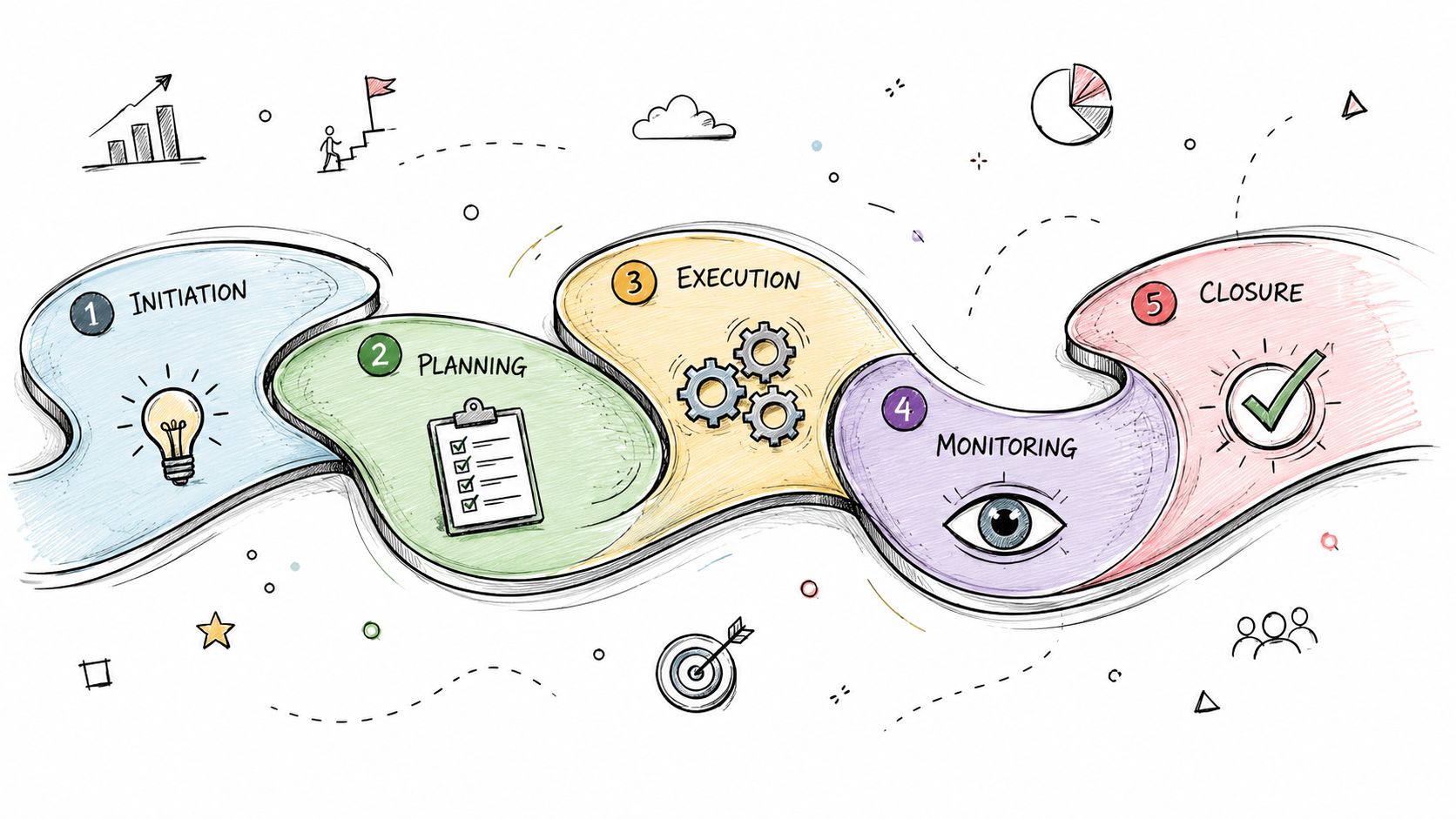
The phase map that keeps finance work moving
| Phase | Core tasks | Typical output |
|---|---|---|
| Initiation | Define the problem, name the sponsor, list stakeholders, set success criteria | Approved project brief |
| Planning | Break down scope, map dependencies, assign owners, build a working timeline | Task plan with sequence |
| Execution | Run check-ins, update status, manage change requests, coordinate handoffs | Completed deliverables |
| Monitoring | Check budget and schedule variance, review quality, re-score risks | Variance and risk update |
| Closure | Get sign-off, document changes, run a retrospective, archive records | Closed project file |
Where the real control work lives
Initiation is where you decide whether the work is worth starting and who has authority over it. Planning is where vague goals become sequenced tasks. In finance projects, that means defining what “done” looks like before the first reconciliation, export, or payroll run starts.
Execution is the visible part, but it only works when the planning was specific. Monitoring is the part often underdone, yet it's where drift gets caught before it becomes a surprise. The Teamwork guidance on project analytics makes the point clearly, project work needs metric-driven control, not just checklists, because comparing actuals against the plan helps spot drift early (Teamwork project management analytics). Closure is where small teams often get lazy. They stop at “it's done” and skip the documentation that would save them next time.
Practical rule: phase boundaries aren't walls. Status reporting and risk review should recur all the way through, not wait until the end.
Three Worked Examples for Bookkeeping and Finance
A good task map gets sharper when you apply it to real finance work. The patterns below are simple, but they show where projects usually wobble. Each one has a different failure point, and each one rewards a different kind of discipline.
Month-end close
The close needs a short, ruthless task list. Reconcile bank and credit card accounts first, because everything downstream depends on those balances being trusted. Then post accruals, review variances against budget, and prepare the financial summary for sign-off.
The highest-risk tasks are the reconciliations and the sign-off. If the accounts aren't clean, every review after that is built on shaky ground. If the summary isn't signed and dated, the project never really closes, it just drifts into next month's mess.
Software migration
A migration from one accounting platform to another should start with data export and integrity checks. After that comes chart-of-accounts mapping, a parallel run for one full cycle, a cutover plan, and explicit rollback criteria.
The parallel run is the task people are most tempted to skip, and that's usually a mistake. It's the only way to see whether the new setup matches the old one before the switch becomes irreversible. The rollback criteria matter for the same reason, they make the cutover a controlled decision instead of a leap of faith. If you need a broader bookkeeping process reference while you plan the handoff, the accounting and bookkeeping category is the right place to think through adjacent workflow changes, not just the software move itself.
Payroll setup
Payroll has the shortest tolerance for error because the external deadline is firm. The core tasks are employee records, tax registrations, time-tracking integration, a test run with a small batch, and then the first live payroll with a manual cross-check.
The test batch is the task that protects the whole process. A manual calculation beside the system output catches rate, deduction, or timing issues before money moves. That's not overcautious. It's the difference between a correction and a reputation problem.
The common thread across all three examples is simple. Not every task carries the same risk. Reconciliations, mapping, testing, and sign-off are the ones that deserve protection when time gets tight.
Prioritization, Assignment, and Tracking That Work
When bandwidth collapses, the wrong question is “what's the plan?” The right question is what gets cut first. In finance work, that answer should already be visible before the pressure shows up, because the sequence you choose determines whether the project slips cleanly or turns into a mess of delayed filings, late approvals, and manual cleanup.
A rule for deciding what survives
Start with the tasks that block other tasks. If one unfinished step stops three others, it stays on the list. Then protect the work tied to outside deadlines, especially tax filings, payroll runs, and vendor payments, because those dates do not move for convenience. After that, protect quality checks and sign-off steps, because skipping them usually creates rework that costs more time than the original task would have taken. Internal nice-to-haves go to the bottom.
The trade-off is straightforward. A task that feels small can still be the gate between on-time and late. In bookkeeping and small-business finance, that often means reconciliation, mapping, review, or approval gets priority over a presentation deck, a status note, or a cleanup item that looks urgent only because it is visible.
Ownership needs one person and one backup
Shared ownership is where work disappears. Two people both assume the other person is handling the reconciliation, and by the time the gap is obvious, the deadline has already shifted. One accountable owner fixes that. A named backup keeps the work moving when the owner is out, in another close, or pulled into a higher-priority issue.
That lines up with practitioner guidance on project challenges, where scope creep, communication gaps, and resource allocation get harder when teams do not make trade-offs explicit (Indeed guidance on project challenges). The practical move is simpler than most planning templates suggest. Decide in advance which tasks get pushed, which get delegated, and which stay protected. Then write those choices down where the team can see them.
Weekly tracking beats constant checking
A short weekly review is usually enough if the task list is honest. Review overdue items, clear blockers, re-rank the next week's top work, and note one risk that could slip the schedule or distort the numbers. That keeps the team honest without turning the week into micromanagement.
The tracking part works best when the same system holds the cadence together. A spreadsheet, a kanban board, or a task list inside your bookkeeping workflow can all work, and a single operating system for the weekly review makes it easier to keep status, ownership, and follow-up in one place. A useful weekly output is specific enough to act on, such as, “AP reconciliation 80 percent complete, owner waiting on one vendor statement, due Thursday, backup assigned if response does not arrive by Wednesday.” That kind of line shows what is moving, what is stuck, and what needs attention next.
Pitfalls That Quietly Wreck Finance Projects
Competent teams still fall into the same traps because the traps feel reasonable in the moment. No one intends to skip a safeguard. They skip it because the project is already late and the shortcut looks harmless. That's exactly why these failure modes deserve attention.

The five mistakes that look small until they aren't
- Vague ownership: “Someone” is handling the reconciliation. Fix it by naming one owner and one backup.
- Skipping the parallel run: The new system goes live without a full cycle in both systems. Fix it by testing side by side before cutover.
- Untested payroll configuration: The first live payroll becomes the test case. Fix it with a small batch and a manual cross-check first.
- Optional monitoring: The project gets status updates only when something is already wrong. Fix it with a fixed weekly variance review against budget and timeline.
- No closure documentation: The team moves on without recording what changed or who owns it now. Fix it with a short closure checklist.
Why these mistakes survive in good teams
Each one is easy to justify in the moment. Ownership feels obvious until it isn't. Monitoring feels redundant until the schedule slips. Documentation feels like overhead until the next quarter repeats the same confusion. That's why these aren't just beginner errors, they're guardrail failures.
The fix is to treat the guardrails as part of the work, not as optional administration. If a close, migration, or payroll setup matters, then the records around it matter too. The project doesn't end when the task is finished. It ends when the handoff is documented and the owner on the other side knows what changed.
A Reusable Weekly Task Review You Can Start Monday
A finance week can go sideways before Tuesday if no one checks the list early. Monday morning gives you a clean point to catch overdue work, confirm who owns each deliverable due that week, and clear anything waiting on a reply or approval. After that, re-rank the next five tasks against outside deadlines and write down the one risk most likely to throw off the schedule.
Keep the routine short enough to repeat
- Review overdue work: note what slipped and the reason it slipped.
- Confirm owners: every deliverable needs one accountable person and a backup if the primary is out.
- Clear blockers: follow up on the dependency instead of leaving it in the queue.
- Re-rank the week: put deadline-sensitive work ahead of work that can wait.
- Record one risk: write down the item most likely to disrupt close, payroll, or a migration step.
A Monday review works because it forces decisions before the week fills up with new noise. A plain spreadsheet can handle it, and so can a board or a checklist inside your finance workflow. If the team is larger or spread across locations, add a documentation owner before you add another meeting. That person keeps the written record current, so the weekly status becomes the shared reference when people are working at different times or in different places.
Here is what a useful Monday output can look like.
Monday review output: Close cleanup, owner Priya, due Thursday, blocked on bank feed update, still red. Payroll mapping, owner Dan, due Wednesday, on track. Migration sign-off, owner Maya, due Friday, waiting on approval, flagged for follow-up by noon. Top risk, vendor file changes may push reconciliation into Wednesday.
Use that output to make the week less fragile. Keep the same review for four weeks without changing the rules, and watch where the work slows down. You will spot bottlenecks earlier, clean up handoffs, and reduce the number of surprises that hit close, payroll, or a migration at the wrong time. For more practical bookkeeping workflow guidance, visit BookkeepDIY to compare bookkeeping workflow tools that support close, payroll, and migration tasks.