
Cash Flow Basics for Solopreneurs: How to Know If You're Actually Profitable
You landed the big client. The invoices are going out. Your calendar is packed, your portfolio is growing, and your business Instagram looks *chef's kiss* successful. But then you check your bank account and… wait, where did the money go? If you're staring at your balance wondering how $10,000 in revenue turned into $200 in actual cash, you're not alone. Most of us have been there, confusing being busy with being profitable.
Here's the truth: when you're flying solo, the line between "crushing it" and "barely surviving" gets blurry fast. You don't have a finance team or fancy accounting software to flag the warning signs. So it's easy to celebrate that $10,000 month while quietly ignoring that software subscriptions, quarterly taxes, and that laptop you bought during a 2 AM deadline panic just ate up most of it.
But here's the good news: you don't need an accounting degree or expensive software to get a clear picture of your financial health. I'm going to walk you through some simple, manual methods to track what actually matters—whether money is staying in your business or leaking out faster than it arrives. By the end, you'll have a straightforward system to answer that nagging question: "Am I actually making money, or just moving money around?"
The Reality Check: Revenue vs. Cash Flow vs. Profit
Before we dive into spreadsheets, let's clear up three numbers that tell very different stories about your business.
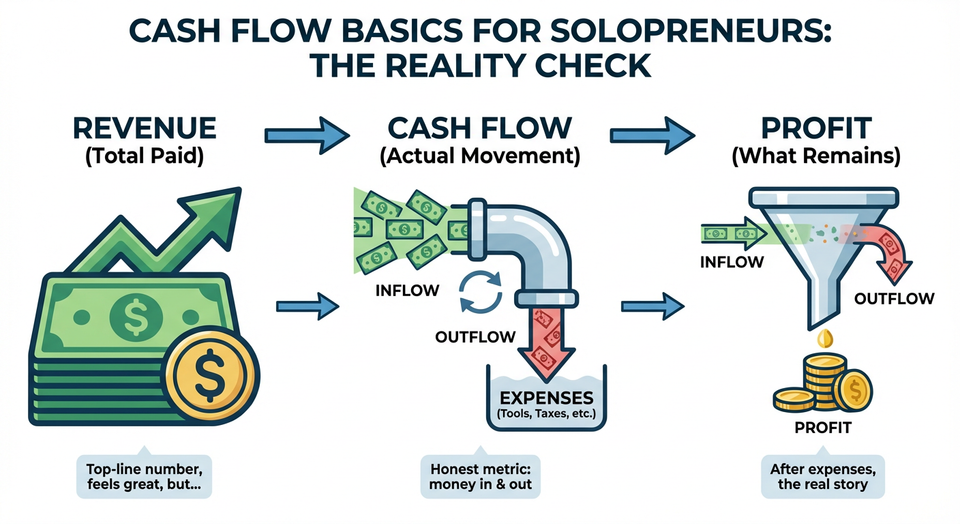
Revenue is the total amount clients pay you—that top-line number that feels great to share but doesn't tell the whole story. Profit is what remains after subtracting business expenses, though this can shift around depending on how you do your books. Cash flow is the most honest metric: it's the actual movement of money into and out of your accounts, timed to when things actually happen.
Here's where it gets tricky for solopreneurs. Let's say you invoice a client $5,000 on December 1st (that's your revenue), pay $3,000 in expenses that month, and celebrate a "$2,000 profit month." But if that client pays net-30 and doesn't send the money until January 10th, your December cash flow was actually *negative* $3,000. You spent money you hadn't received yet. Ouch.
Simple fix: Stop using your invoicing software's "profit and loss" report as your financial gospel. Start tracking when money actually hits your bank account versus when it leaves. That's your real cash flow reality, and it's what keeps the lights on.
The "Three-Bucket" Tracking Method
You honestly don't need QuickBooks to understand your business. You just need three categories and a simple spreadsheet—or hey, even a notebook works. Every Friday, spend 15 minutes categorizing every transaction from the week into these buckets:
Operating Cash (Money for Today): This covers your immediate business survival—software subscriptions, internet, contractor payments, and the paycheck you need to pay your rent. If you stopped earning tomorrow, these are the non-negotiables keeping the lights on.
Tax Reserve (Money for the Government): Solopreneurs get shocked by quarterly taxes. The moment money hits your account, 25-30% needs to be mentally quarantined. Create a separate savings account labeled "Taxes" and transfer this percentage immediately, before you start seeing it as spending money.
Owner's Pay (Money for You): What's left after operating expenses and taxes. If this number is consistently zero or negative, you're running a hobby that happens to generate invoices, not a profitable business. And you deserve better than that.
Practical implementation: Open two free checking accounts at your bank—one for operations, one for taxes. When a client payment arrives, immediately split it: 30% to the tax account, the remainder to operations. Your "salary" is what you can sustainably withdraw from the operations account without dipping into the tax reserve. Trust me, future-you will thank present-you when tax season rolls around.
The Break-Even Date Calculation
Most solopreneurs calculate profitability monthly, but cash flow doesn't care about calendar pages. Instead, calculate your Break-Even Date—the day each month when you've earned enough to cover that month's fixed costs.
Here's how it works. First, add up your non-negotiable monthly expenses: software ($200), insurance ($400), coworking space ($300), and the minimum salary you need to survive ($3,000). That's $3,900 in fixed costs.
If you charge $100/hour, you need 39 billable hours to break even. If you hit that by the 15th of the month, every hour after is profit. If you hit it on the 28th, you're running dangerously close to the edge—and you might need to make some changes.
The "Actual Hourly" Reality Check: Okay, let's be real with each other. You might bill $100/hour, but if you spend 10 hours on admin,