
You can have your busiest month ever and still feel broke.
That's the moment when most freelancers first ask, in plain terms, what is net cash flow and why doesn't it match the “profit” number in their reports. You finished projects, sent invoices, maybe even showed a healthy net income. But rent is due, payroll is due, software renewals hit, and your checking account says something very different.
I've seen this over and over in small business books. The owner isn't careless. They're reading the wrong signal. Profit tells you whether the business earned money under accounting rules. Net cash flow tells you whether cash moved in and out of the business during the period. That's the number that decides whether you can comfortably pay bills today.
A simple way to think about it is your personal bank account. If your employer says you earned money this month but the deposit hasn't cleared yet, you can't spend that paycheck. Your business works the same way. Money on paper and money in the bank are related, but they aren't the same thing.
Why "Profitable" Businesses Can Still Go Broke
A freelance designer wraps up a strong quarter. The invoices look great. The profit report looks even better. Then the anxiety starts.
Two clients still haven't paid. Quarterly taxes are coming up. A contractor needs to be paid this week. The bank balance is lower than expected, and the business owner starts wondering how that can happen when the business was “profitable.”
That disconnect is exactly why net cash flow matters. A business is cash flow positive when cash inflows exceed cash outflows, and cash negative when outflows exceed inflows, which can erode liquidity and make it harder to stay stable in the short term, as explained in NetSuite's overview of business cash flow.
Profit is a report. Cash is survival.
Profit can include sales you've earned but haven't collected yet. Cash flow focuses on what entered and left the bank. For a freelancer, that difference often comes down to timing.
You might send an invoice on the last day of the month and count that revenue in your books. But if the client pays next month, the cash isn't available yet. Meanwhile, your expenses are very real and very current.
A profitable business can still struggle if cash arrives too late.
This is also where working capital starts to matter. If too much cash is tied up in unpaid invoices, inventory, or other short-term needs, your business may look fine on paper while feeling squeezed day to day.
The pain shows up in ordinary bills
Most owners don't notice the problem in a spreadsheet first. They notice it when they can't comfortably cover:
- Regular overhead: Rent, internet, subscriptions, and insurance still have to be paid on schedule.
- People costs: Payroll, contractor payments, and owner draws can't wait for late client payments forever.
- Debt obligations: Loan payments are cash outflows whether your clients paid you or not.
That's why net cash flow is the better short-term health check. It answers the practical question every owner eventually asks: Do I have enough real cash to keep operating without stress?
The Three Pillars of Net Cash Flow
The easiest way to understand net cash flow is to picture three buckets. Every cash movement in the business lands in one of them. Add the three buckets together, and you get your total net cash flow for the period.
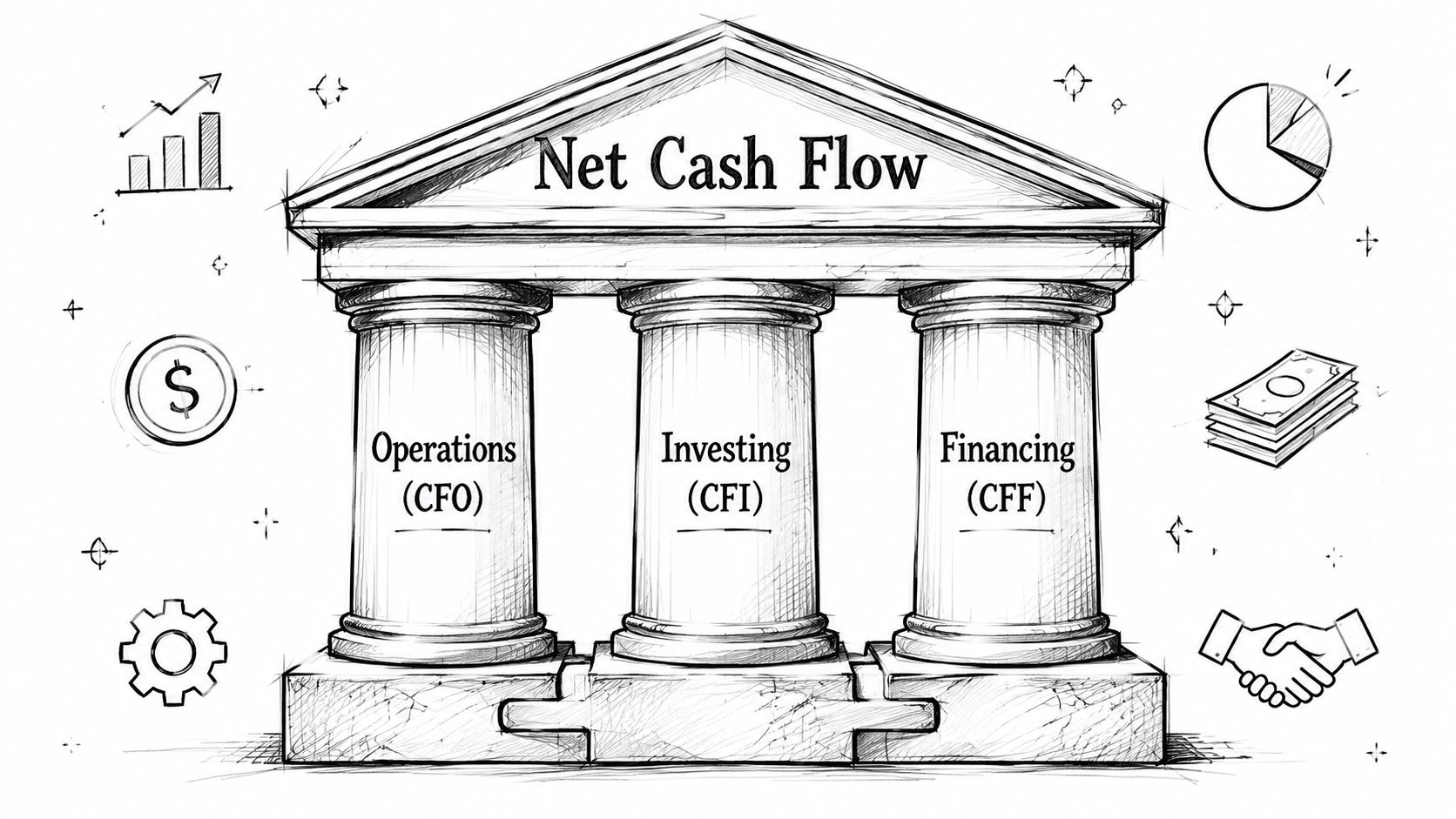
Operating cash flow
This is the day-to-day bucket. For a freelancer or small business, it usually includes client payments coming in and ordinary business expenses going out.
Think of things like customer receipts, software subscriptions, office rent, payroll, contractor payments, and taxes. If your business is healthy at its core, this bucket should generally tell a good story over time.
Investing cash flow
This bucket tracks money spent on or received from long-term assets.
For a solo business, that might mean buying a new laptop, camera, desk setup, or other equipment. These purchases often reduce cash in the short term, even if they help you earn more later.
Financing cash flow
This bucket covers cash tied to funding the business.
Examples include loan proceeds coming in, loan repayments going out, or an owner putting personal money into the business. This is the bucket that often confuses people, because it can make cash flow look strong even when operations are weak.
Practical rule: Don't stop at the final net cash flow number. Check which bucket created it.
The formula in plain language
Under standard cash flow reporting, net cash flow is the sum of operating, investing, and financing cash flow, a structure used in the Statement of Cash Flows under U.S. GAAP and IFRS. Wall Street Prep explains this framework and gives a simple example: if cash flow from operations is $500,000, cash flow from investing is -$150,000, and cash flow from financing is $200,000, the resulting net cash flow is $550,000.
You don't need a finance degree to use that formula. You just need to sort each cash movement into the right bucket, then total them.
Here's a quick mental checklist:
- Operations asks: Did cash come from serving clients and running the business?
- Investing asks: Did cash move because you bought or sold long-term assets?
- Financing asks: Did cash move because you borrowed, repaid debt, or added capital?
When owners learn this three-bucket view, net cash flow usually stops feeling abstract. It becomes a readable story about how the business is being funded.
Net Cash Flow vs Net Income Explained
If you only remember one distinction, remember this: net income is not the same as net cash flow.
Net income comes from your income statement. It measures revenue minus expenses under accounting rules for a period. Net cash flow measures the actual movement of cash.
Why the numbers drift apart
A freelancer can record revenue before the client pays. That increases profit, but not cash yet. The opposite can also happen with expenses. Some costs reduce profit even though they don't involve an immediate cash payment in that same period.
Then there's timing. You may pay for annual software upfront, buy equipment, or collect a deposit before doing the work. Each of those changes cash differently from profit.
The bank balance follows cash timing, not accounting timing.
A simple side-by-side example
Here's a basic way to see the gap.
| Item | Amount |
|---|---|
| Net income | Positive |
| Revenue earned but not yet collected | Reduces available cash |
| Cash paid for equipment | Reduces cash but may not fully reduce current profit |
| Loan proceeds received | Increases cash but does not increase net income |
| Owner contribution | Increases cash but does not increase net income |
| Net cash flow | Depends on all cash moving in and out |
That's why a profitable month can still feel tight. Profit can rise because of earned revenue, while cash stays low because customers haven't paid yet or because you spent cash on equipment and debt payments.
Another way some owners think about liquidity
Some financial analysis also looks at net cash flow through working capital. An alternative formula is NCF = WC - WCR, and one example shows that if working capital is 1,100 and working capital requirement is 600, net cash flow is 500, reflecting immediate liquidity available for use, as described in Agicap's explanation of the working capital approach to net cash flow.
You don't need to calculate it that way every week. But it's a useful reminder that liquidity depends on how your operations tie up cash, not just whether the business looks profitable.
Calculating Net Cash Flow A Practical Example
Let's walk through this like I would with a new freelance client.
A web designer finishes the month with client work completed, normal business expenses paid, one equipment purchase, and a small loan deposit. The goal is simple: sort the cash activity into the three buckets, then total it.

Step one, list the cash movements
Start with what hit the bank account.
- Operating activity: Client payments received, software bills paid, rent paid, contractor paid
- Investing activity: Purchase of a new monitor for the studio setup
- Financing activity: Proceeds from a small loan deposited into the business account
Notice what's missing here. We're not starting with invoices sent. We're not starting with profit. We're starting with cash.
Step two, group them into the three buckets
For a freelancer, this usually looks like:
- Operations: The normal flow of serving clients and paying routine expenses
- Investing: Bigger asset purchases that support future work
- Financing: Borrowing or owner funding that changes the cash position but doesn't come from core services
Once you've grouped everything, total each bucket. Then add those totals together.
If your bookkeeping is organized correctly, this calculation is mostly sorting, not advanced math.
Step three, read the result carefully
If the final number is positive, that means more cash came in than went out during the period. If it's negative, more cash left than entered.
But don't stop there. A positive result could mean healthy operations, or it could mean a loan temporarily boosted the bank balance. That distinction matters a lot for a freelancer trying to decide whether they can hire help, take an owner draw, or commit to a new monthly expense.
A clean month is one where the cash story makes sense. Client work brings in cash. Ordinary expenses are controlled. Asset purchases are intentional. Financing is a support tool, not the only reason the account stayed above zero.
Common Pitfalls When Interpreting Net Cash Flow
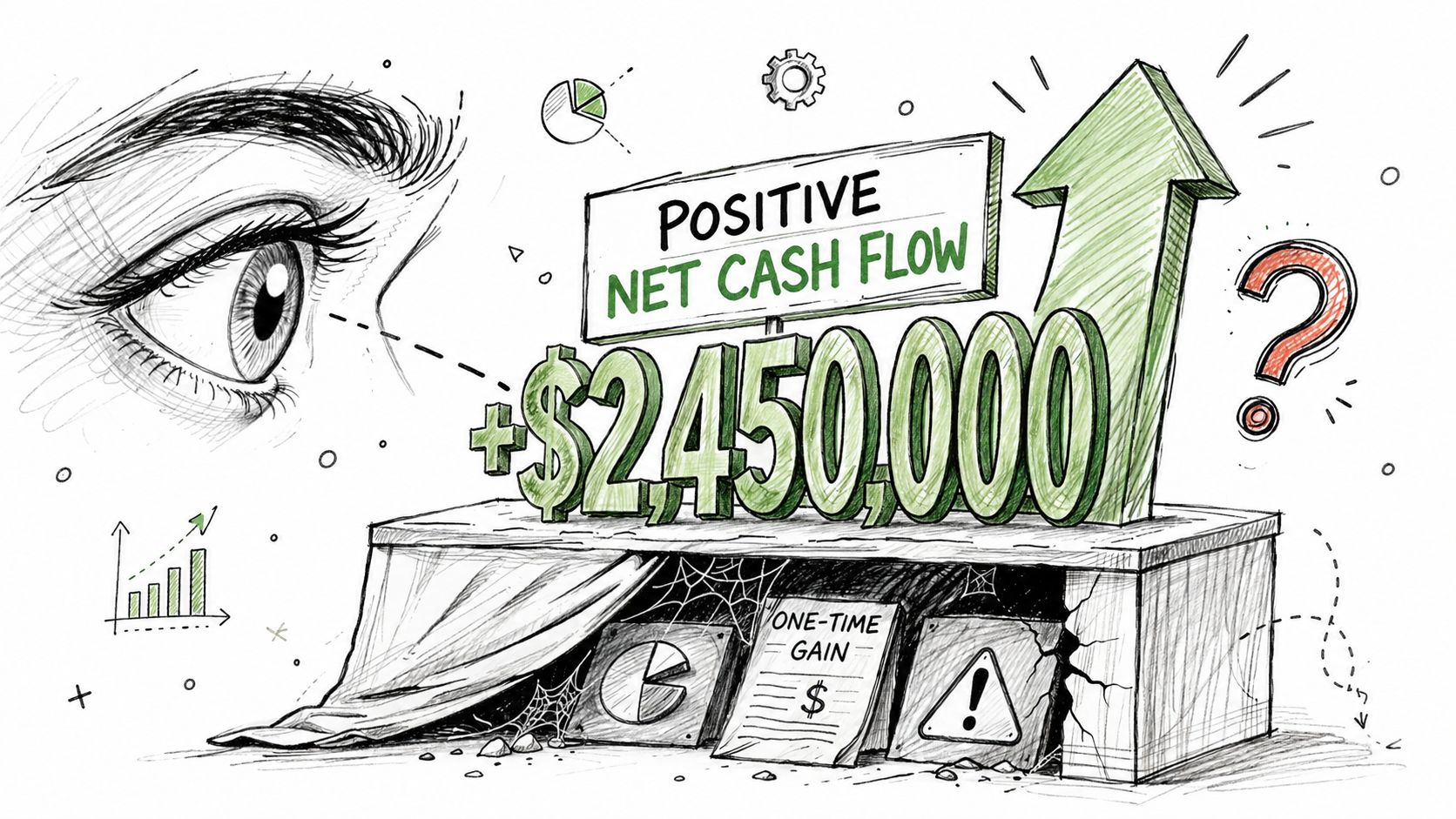
A lot of owners see a positive net cash flow number and relax too soon.
That's understandable. More cash came in than went out. On the surface, that sounds healthy. But the mix matters just as much as the total.
Positive cash flow can hide a weak business core
The most dangerous mistake is treating borrowed cash like earned cash.
A loan deposit increases your cash balance. So does putting personal money into the business. Those moves can be necessary and sometimes wise. But they do not prove your business operations are generating enough cash on their own.
This isn't a rare edge case. Data shows that 42% of small U.S. businesses report negative operating cash flow despite having a positive total net cash flow, often due to financing activity like taking on new loans, according to Neat's discussion of the net cash flow formula.
What to watch for
If you want to read the story behind the number, pay attention to these patterns:
- Strong operations, modest investing, limited financing: Usually a healthier sign. The business is producing cash through normal work.
- Weak operations, positive total cash flow, heavy financing: A warning sign. Borrowing may be covering a core operating problem.
- Negative cash flow during planned investment: Sometimes normal. A business may spend cash on equipment or growth intentionally.
- Repeated operating shortfalls: This needs attention fast. It often means pricing, collections, spending, or project margins need work.
Borrowed cash can solve a timing problem. It can't permanently fix an unprofitable operating model.
The final number is only the headline
Think of total net cash flow as the headline and the three categories as the actual article.
If operations are consistently negative, the business may be surviving on temporary support. That can buy time, but it shouldn't be mistaken for stability. A freelancer who understands this early usually makes better decisions about pricing, payment terms, and fixed costs.
One more nuance matters for owners who also think about valuation. Net cash flow and unlevered free cash flow are not the same. Net cash flow includes financing flows like interest and debt activity, while valuation models often use a measure that strips financing effects out. That difference matters when you're trying to understand daily liquidity versus business value.
How to Track Net Cash Flow With Your Bookkeeping Tools
You don't need to build this from scratch in a spreadsheet every month. Most bookkeeping systems can generate a Statement of Cash Flows for you.
Where to look
Open your reports area and look for a report labeled “Statement of Cash Flows” or “Cash Flow Statement.” That report usually separates activity into operating, investing, and financing sections. If your books are current and your transactions are categorized correctly, the report does most of the heavy lifting.
How to make the report useful
Use a simple routine:
- Run it monthly: Don't wait until tax time.
- Compare periods: Look for changes in operations, not just the final total.
- Match it to the bank balance: The ending change in cash should make sense alongside your actual bank activity.
- Review the financing section closely: New debt can make the month look stronger than it really was.
If you're evaluating tools that make cash visibility easier, a directory page like this overview of Float can help you see what fits a small business workflow.
Frequently Asked Questions About Net Cash Flow
Is positive net cash flow always good
Not automatically. Positive net cash flow is good news only when you understand where it came from. If it came from solid operations, that's encouraging. If it came mainly from loans or owner injections, you need to be more careful in how you interpret it.
Is negative net cash flow always bad
No. A business can have negative net cash flow during a period of planned investment, such as buying equipment or making a deliberate growth move. The key question is whether the business has a clear reason for the outflow and enough liquidity to handle it.
What is net cash flow in the simplest possible terms
It's the net change in cash over a period. More cash in than out means positive net cash flow. More out than in means negative net cash flow.
Why does my profit look fine while my cash feels tight
Usually because revenue and cash collection happen at different times, or because cash went toward things that don't show up the same way in profit. Late client payments, equipment purchases, debt payments, and owner transactions often create that gap.
Is net cash flow the same as free cash flow
No. They're related, but they answer different questions. Net cash flow looks at the total change in cash across operations, investing, and financing. Free cash flow is a different analytical measure used for different purposes.
If you're trying to make sense of reports without drowning in accounting jargon, BookkeepDIY is a practical place to start. It gives freelancers and small business owners plain-English bookkeeping definitions, useful software directory pages, and guidance that helps you choose tools and understand the numbers behind them.