
Contribution margin is the money each sale generates to pay for fixed costs and create profit. It's calculated as sales revenue minus variable costs, so if you sell something for $50 and the variable cost is $30, the contribution margin is $20 and the contribution margin ratio is 40%.
If you're a freelancer or small business owner, this is often the missing number behind a very common feeling. Sales are coming in, clients are paying, orders are moving, but you're still not fully sure whether each sale is helping the business or just keeping you busy.
That's why people search for what is the contribution margin. They don't really want a textbook definition. They want to know whether a service, product, or marketing campaign is pulling its weight.
A good bookkeeper looks at contribution margin because it answers a practical question: after the direct costs of making a sale are covered, how much is left to support the business? Once you understand that, pricing gets clearer, break-even stops feeling abstract, and marketing decisions get a lot easier.
Understanding Your Profitability Per Sale
A lot of owners look at revenue first. That makes sense. Revenue is visible. It's the top line on your reports, and it's often the number you notice when a week feels good.
But revenue alone doesn't tell you whether a sale helped the business.

Think about two simple situations:
- A freelancer books a project and gets paid, but also hires a subcontractor, pays payment processing fees, and spends money to land the client.
- A shop owner makes a sale but still has to cover materials, packaging, shipping, and transaction fees.
In both cases, the owner made a sale. What they need to know next is what remains after the costs tied directly to that sale are removed.
That remaining amount is the contribution margin.
What the number really means
The formal definition is straightforward. The contribution margin is the difference between total sales revenue and total variable costs. The same idea also works on a per-unit basis. A positive contribution margin means the sale covers its variable costs and helps pay fixed costs and profit. A negative contribution margin means the sale is hurting the business, no matter how carefully you manage overhead, as explained by Munich Business School's contribution margin definition.
Plain-English version: contribution margin tells you how much money a sale leaves behind for the rest of the business.
That's why this metric matters so much for small businesses. If you sell handmade goods, you can use it to judge whether an item deserves shelf space. If you sell services, you can use it to see whether a project is worth accepting at your current price.
Why new owners get tripped up
Most confusion comes from one mistake. People mix up money coming in with money earned.
A sale can look healthy but carry too many direct costs. On the other hand, a lower-priced offer can be surprisingly strong if it leaves plenty behind after those costs are paid.
Contribution margin helps you answer questions like these:
- Should I keep offering this service?
- Can I afford to discount this product?
- Is this client profitable after direct delivery costs?
- Is my growth helping the business?
Once you see sales through that lens, the math starts serving decisions instead of just sitting in a spreadsheet.
How to Calculate Contribution Margin
A simple sale can look profitable until you separate the money you keep from the money that goes right back out. That is what this calculation does.
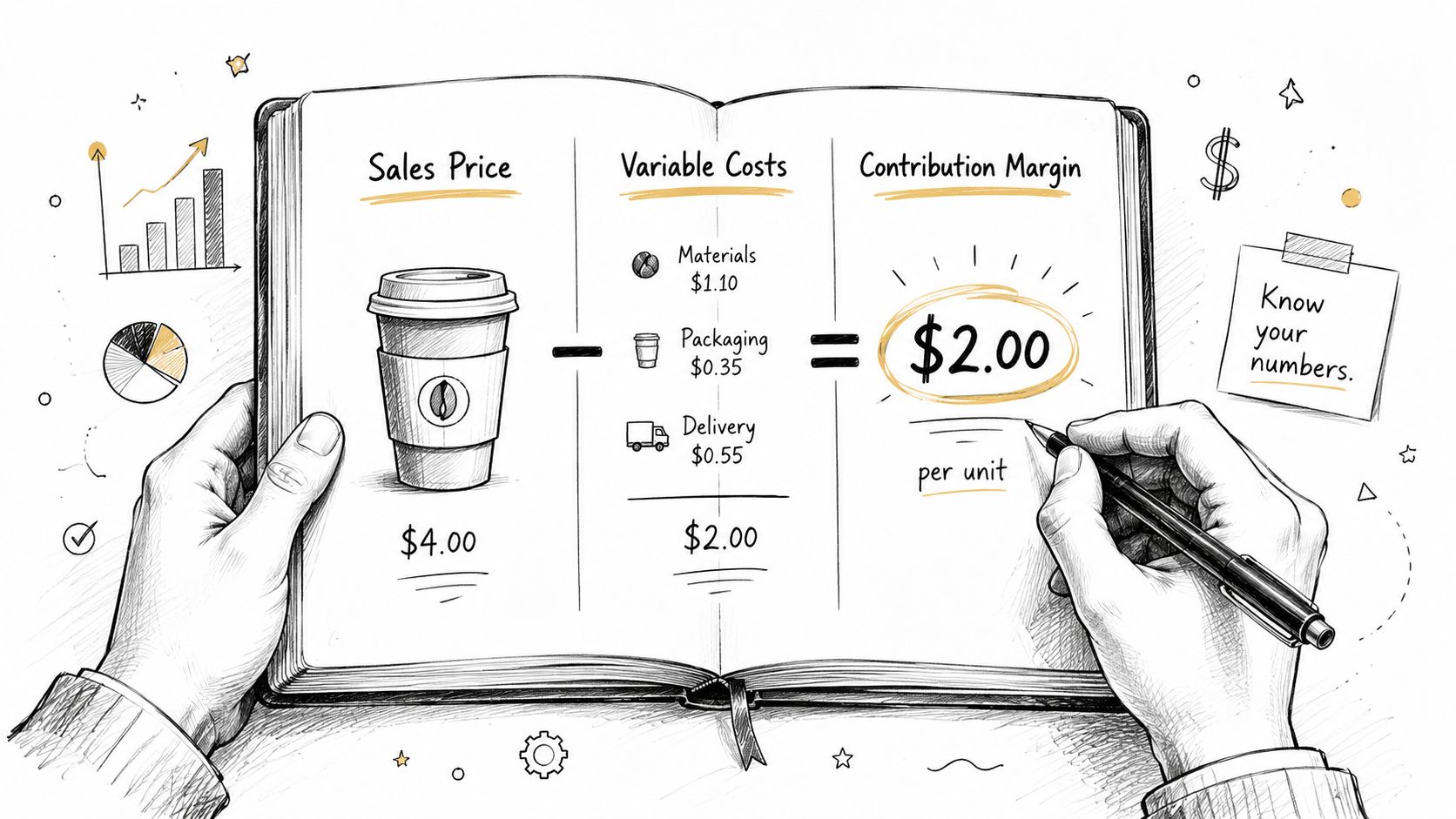
Say you sell a coffee mug for $50. It costs you $30 in variable costs to make and deliver that mug. What is left is $20. That $20 is the contribution margin for that sale.
For a freelancer, the same math works. If you charge $500 for a project and spend $125 on contractor help, payment processing, and other delivery costs that rise with the job, your contribution margin is $375.
Per-unit contribution margin
Start with the version that answers the most practical question: what does one sale leave behind?
Contribution margin per unit = Selling price per unit − Variable costs per unit
Using the mug example:
- Selling price per unit = $50
- Variable costs per unit = $30
- Contribution margin per unit = $20
That means each mug leaves $20 to help cover fixed expenses, such as rent, software, insurance, and owner pay.
The tricky part is usually the variable cost side. A good rule is this: if the cost rises because you made one more sale, it probably belongs here. Materials, packaging, shipping, card fees, and other direct costs tied to each sale often fit.
Total contribution margin
Per-unit margin helps with pricing. Total contribution margin helps you judge a product line, service category, client type, or month of sales.
Total contribution margin = Total sales revenue − Total variable costs
If you sold 100 mugs in a month:
- Total sales revenue = $5,000
- Total variable costs = $3,000
- Total contribution margin = $2,000
This shifts the question from the contribution of a single mug to the contribution of the entire product line.
That wider view matters for small businesses. You pay bills with the combined leftovers from many sales, not with the economics of one transaction in isolation.
A product or service earns its place by leaving enough behind across many sales, not by looking impressive at the top-line revenue level.
Contribution margin ratio
The ratio turns the same idea into a percentage, which makes it easier to compare offers with different prices.
Contribution margin ratio = (Contribution margin / Sales revenue) × 100
Using the mug example:
- Contribution margin = $20
- Sales revenue = $50
- Ratio = 40%
That means 40 cents of every sales dollar remains after variable costs.
This percentage is especially useful when you are deciding how much you can spend to win a sale. If your service has a 60% contribution margin ratio, you have more room for ads, referral fees, or sales commissions than a business working with a 20% ratio. Freelancers and small firms can use that number to judge whether a marketing channel is bringing in work that supports the business.
A quick summary
| Measure | Formula | What it tells you |
|---|---|---|
| Per-unit contribution margin | Selling price per unit minus variable costs per unit | How much one sale leaves behind |
| Total contribution margin | Total sales revenue minus total variable costs | How much a product, service, or time period contributed overall |
| Contribution margin ratio | Contribution margin divided by sales revenue, then multiplied by 100 | How much of each sales dollar remains after variable costs |
A bucket works as a good mental picture. Revenue pours in from the top. Variable costs leak out through holes near the bottom. Contribution margin is the water still left in the bucket after those leaks.
That is the number you can use. It helps you price work, test discounts, and decide whether a marketing campaign is producing sales that are worth keeping.
Contribution Margin vs Gross Margin Explained
People often use these terms as if they mean the same thing. They don't.
Both are useful. But they answer different questions, and if you mix them up, you can make bad pricing and product decisions.
The core difference
Contribution margin subtracts variable costs from revenue.
Gross margin subtracts cost of goods sold from revenue.
The distinction matters because variable costs are broader than many owners expect. Contribution margin is built for internal decisions about what to sell, what to promote, and what to change. Gross margin is useful, but it doesn't isolate sale-by-sale contribution in the same way.
If you want a plain-language refresher on the related term, see gross margin.
Contribution Margin vs. Gross Margin at a Glance
| Attribute | Contribution Margin | Gross Margin |
|---|---|---|
| Main purpose | Shows what a sale contributes toward fixed costs and profit | Shows profit after cost of goods sold |
| Costs subtracted | Variable costs | Cost of goods sold |
| Best use | Pricing, product mix, break-even thinking, short-term decisions | Basic profitability reporting |
| Best question answered | "Does this sale help support the business?" | "How much is left after direct production cost?" |
| Works well for services | Yes, if you identify variable delivery costs | Sometimes, but often less intuitive for service work |
| Marketing costs included | Can be included when they vary with acquiring the sale | Usually not the focus |
Why the distinction matters in real life
Take a service business. You might look at gross margin and feel fine because the direct labor cost appears manageable. But if each new client also requires a referral fee, payment fee, or ad spend to acquire them, contribution margin gives you the more decision-ready view.
For a product business, the same issue appears in a different form. Gross margin can look healthy while shipping, fulfillment, and other sale-driven costs eat away what's really left.
Gross margin is useful for reporting. Contribution margin is usually better for deciding.
A quick mental check
Use gross margin when you want a broad view of production profitability.
Use contribution margin when you're deciding whether to:
- Raise or lower price
- Push one offer over another
- Run a promotion
- Keep or cut a product or service
- Judge whether more sales will help
That's why small business owners benefit from learning contribution margin early. It gives you a more practical answer to the question behind most financial stress: "If I sell more of this, will my business be better off?"
How to Use Contribution Margin for Better Decisions
A freelancer books a $1,200 project and feels good about the sale. However, the full financial picture emerges. Payment processing takes a cut, a subcontractor handles part of the work, and the client came from a paid ad campaign. The invoice still says $1,200, but the amount left to support rent, software, and the owner's paycheck is much smaller.
That is where contribution margin becomes useful in daily decision-making. It answers a practical question: after the sale-specific costs are paid, how much is left to help cover the rest of the business?
Break-even becomes a target you can manage
Contribution margin is what carries your fixed costs. If each sale leaves something behind, those dollars stack up until they cover expenses like rent, insurance, software subscriptions, and salaried admin help.
The basic formula is:
Break-Even Point (units) = Total Fixed Costs / Contribution Margin Per Unit
For example, if fixed costs are $100,000 and each unit contributes $20, the business needs to sell 5,000 units to break even. Profit starts only after total contribution margin exceeds total fixed costs.
If you want a simple definition of the related concept, see how break-even point works.
For a small business owner, this turns a vague goal into a number you can use. You can ask, "How many client projects, product orders, or retainers do I need this month?" and get a usable answer.
Better offers become easier to spot
Revenue can be loud. Contribution margin is quieter, but more useful.
Suppose you offer two packages. Package A sells for more, but it includes more hands-on time, extra revisions, and a contractor who bills per project. Package B has a smaller invoice, but it is simpler to deliver and has fewer sale-specific costs. The better choice is the one that leaves more behind after delivery.
A simple review process helps:
- Pull the income from each offer or service line.
- List the costs that rise when that offer sells again.
- Subtract those costs from the sale price.
- Compare which offer contributes more dollars or a stronger percentage.
This matters for product businesses and service businesses alike. A busy offer can keep you occupied all month and still contribute less than a smaller, simpler one.
Marketing decisions get clearer
Many owners stop at product cost or labor cost. That misses part of the picture.
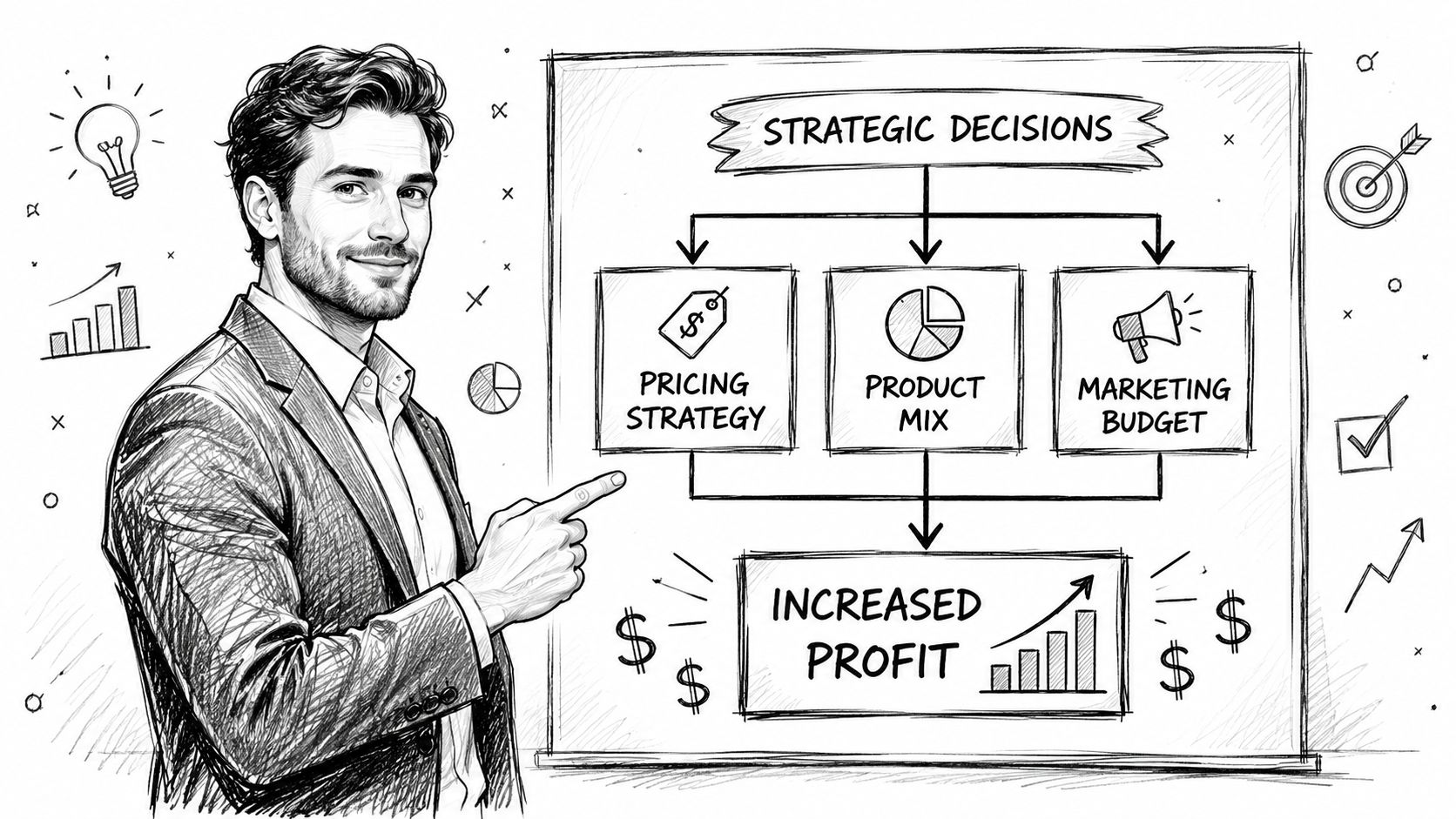
If a sale only happens because you paid for an ad, a lead fee, an affiliate commission, or a referral payout, that cost may belong in the decision. For freelancers and small businesses, this is often the difference between growth that helps and growth that drains cash.
Here is the practical question to ask: after the ad cost and delivery cost, does this sale still leave enough to support the business?
For example, a designer might sell a $900 package with $150 of subcontractor cost and $30 of payment fees. That looks decent at first glance. But if the client also required $250 in ad spend to acquire, the contribution left is now much tighter. That does not mean the sale was bad. It means the owner can judge the campaign with open eyes.
Pricing and discount decisions become less emotional
Discounts feel harmless when you only look at revenue. Contribution margin shows what the discount takes away.
If your variable costs stay mostly the same, every dollar you cut from price usually comes straight out of contribution. A 10 percent discount does not just reduce sales revenue. It reduces the dollars available to cover fixed costs.
Before you run a promotion, check three things:
- What is the contribution margin before the discount?
- What sale-specific costs will stay the same after the discount?
- Will the lower-priced sale still leave enough to justify the work or ad spend?
That quick check can keep you from filling your calendar with work that looks busy but pays poorly.
A monthly habit that works
You do not need a complicated spreadsheet to use contribution margin well.
Once a month, review a few core offers, your direct fulfillment costs, and any marketing spend tied to getting those sales. Then ask which sales help cover the business and which ones mainly create activity.
That is the true value of contribution margin. It helps you choose better clients, price with more confidence, and spend marketing dollars where they have a real chance of paying you back.
Common Pitfalls and Advanced Applications
A small classification mistake can make a healthy sale look weak, or make a weak sale look better than it really is.
That happens because contribution margin depends less on complicated math and more on putting each cost in the right bucket. For a freelancer, that might mean separating a one-time project expense from a monthly software subscription. For a shop owner, it might mean knowing the difference between packaging used on each order and rent that stays the same whether you ship 10 orders or 100.
The most common errors
One common mistake is treating any sales-related cost as variable. A cost is variable only if it rises when you make one more sale. Your monthly bookkeeping software, regular phone bill, or flat retainer for admin support may help the business run, but those costs usually do not belong in contribution margin.
The opposite mistake is just as common. Owners leave out small per-sale costs because each one seems minor on its own. Payment processing fees, rush delivery charges, affiliate commissions, and client-specific revisions can eat into what each sale contributes.
Watch for these trouble spots:
- Fixed costs disguised as direct costs. If the expense stays the same next month even with fewer sales, it likely is not variable.
- Small transaction fees that add up. Card fees, marketplace fees, and per-order shipping charges can materially reduce contribution.
- Service delivery costs that are easy to miss. Freelancer subcontractor help, project-specific apps, printing, travel, and fulfillment labor often belong in the calculation.
- Blended marketing spend. A general brand campaign is usually harder to tie to one sale, but a paid ad campaign tracked to a specific offer may belong in a separate marketing contribution view.
One bad category can throw off the whole picture.
An advanced use many small businesses overlook
Contribution margin is also useful for judging whether your marketing is paying for itself.
For freelancers and small businesses, this is often the next step after learning the basic formula. You start with revenue, subtract the direct cost to deliver the work or product, and then, for a specific campaign, subtract the cost to get that sale. That gives you a practical view of whether growth is helping the business or just keeping you busy.
A simple rule of thumb helps here. If the contribution left after direct fulfillment costs is not comfortably larger than the customer acquisition cost, growth may be creating revenue without creating much real benefit. Many owners use a target of several times CAC as a safer buffer, especially when cash is tight or delivery work is labor-heavy.
That matters because marketing can look successful on the surface. The campaign brought in leads. Sales went up. The calendar filled. But if ad spend and fulfillment costs absorb most of the money from those sales, the business gains activity more than profit.
A better way to test marketing spend
Ask a more specific question than, "Did the campaign work?"
Ask:
- How much revenue came from that campaign or channel?
- What did it cost to fulfill those sales?
- What did I spend to acquire them?
- What amount was left to help cover overhead and profit?
That last number is the one that helps you decide what to do next.
If you are a freelancer, this can show whether low-ticket discovery offers lead to worthwhile client work. If you run a small online store, it can show whether a paid promotion still makes sense after returns, shipping, and transaction fees. If you sell services, it can help you spot a painful pattern: clients acquired through one channel may bring decent revenue but require so much delivery time and ad spend that they leave very little behind.
Contribution margin is useful because it turns "Are sales up?" into "Are these sales helping?"
How to Find Your Numbers in Accounting Software
The good news is that you probably already have most of the numbers. The challenge is knowing where to look and how to sort them.
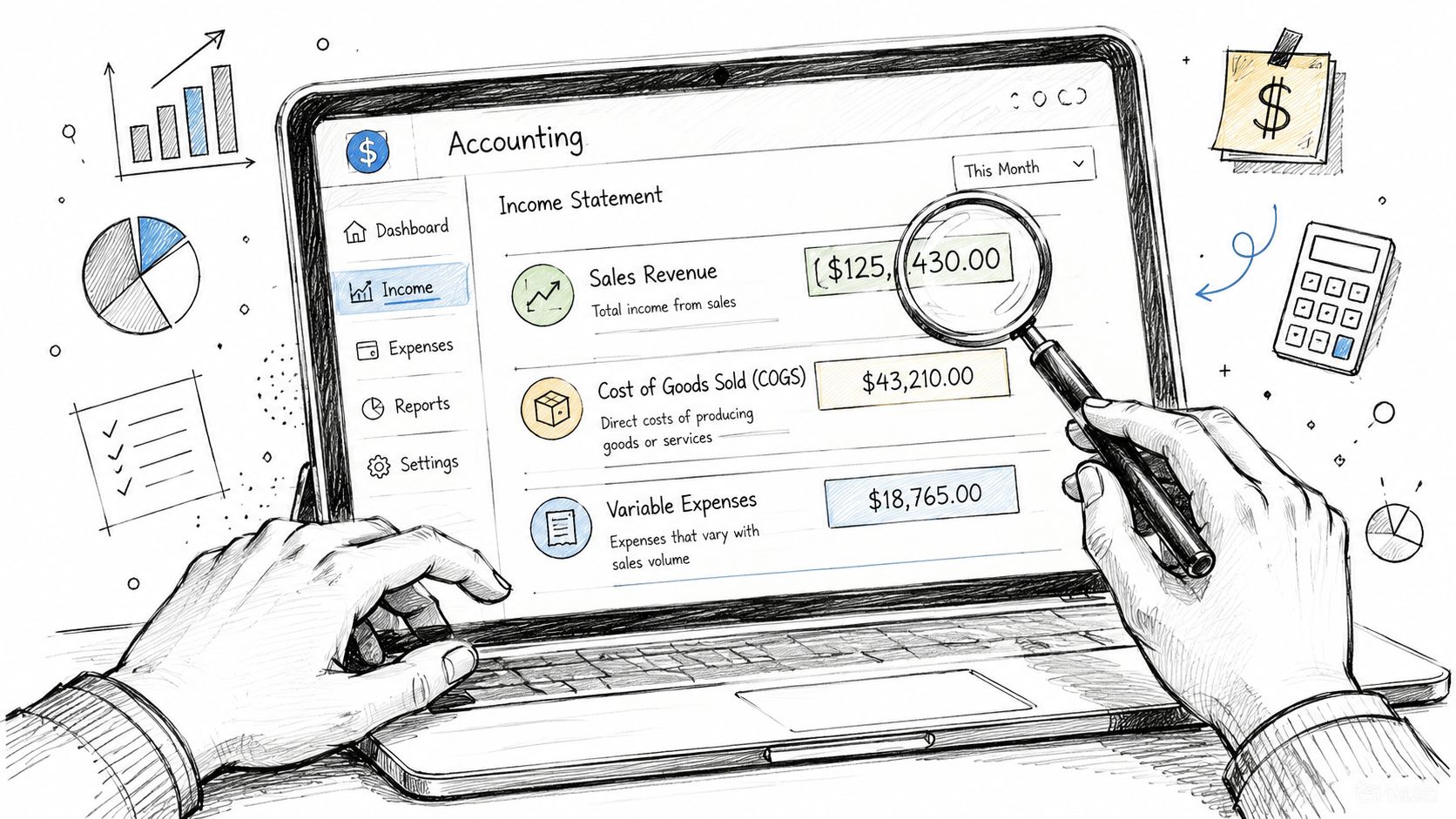
Start with your income statement
Open your Profit and Loss report, sometimes called the Income Statement, for a recent month.
You're looking for two broad groups:
- Revenue from the product or service you want to evaluate
- Costs that move with each sale, such as materials, shipping, fulfillment, payment processing, commissions, or project-specific subcontractor costs
If your books are well categorized, those numbers may already be visible by account. If not, you may need to review transaction detail to separate variable expenses from fixed overhead.
Then sort expenses by behavior
This is the part that matters most. Don't sort by whether a cost feels important. Sort by whether it changes when sales change.
A simple approach:
- Pull one month of revenue
- List direct sale-related costs
- Exclude fixed costs like regular rent or flat monthly admin software
- Group costs by offer, product line, or service type when possible
- Run the contribution margin calculation manually until your categories are reliable
What to look for in your chart of accounts
Your chart of accounts should make direct costs easier to spot. If everything is piled into broad labels, contribution margin becomes harder to calculate.
Useful categories often include:
- Materials or direct supplies
- Merchant or payment processing fees
- Shipping or fulfillment
- Sales commissions or referral costs
- Project-specific contractor costs
- Campaign costs tied directly to customer acquisition
If your reports don't separate variable and fixed costs clearly, the problem usually isn't the formula. It's the bookkeeping setup.
Once those categories are clean, the calculation gets much easier. You can review a month, a service line, or a product category and see which sales are supporting the business.
If you're learning bookkeeping as you go, BookkeepDIY can help you make sense of terms like contribution margin, compare finance back-office software, and build a clearer system for tracking the numbers that drive decisions.