Accora
Embedded tax estimates and accountant-signed filing for fintech apps. Not bookkeeping software for a US shop.
- Starting price
- Custom (per user, per return, or revenue share)
- Pricing
- Contact sales
- Pricing checked
- October 21, 2026
Our take
- Best for
- A fintech app in the UK, Italy, Malta, or another jurisdiction Accora already staffs, that wants tax estimates in its own interface and a local accountant to sign the return.
- Not ideal if
- A US owner or firm that wants software to categorize QuickBooks or Xero, or to file a 1040, 1120, or 1065. There is no public signup for that job.
- Standout
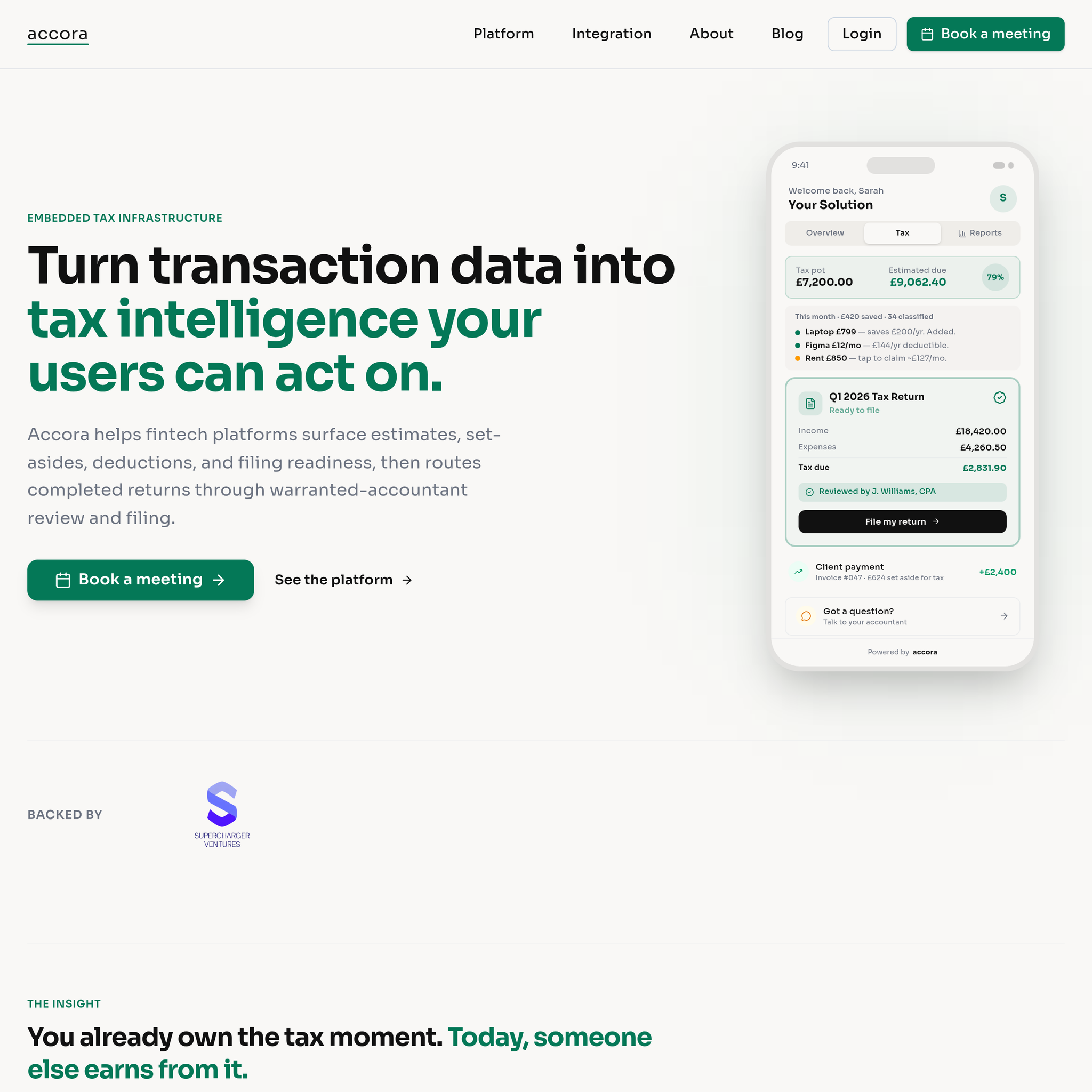
- The host app shows the tax pot, and every return still goes to a warranted accountant who signs and files.
About Accora
Accora is tax infrastructure for a fintech app, not bookkeeping software you open for your shop. The platform sends transactions by API, or from a bank feed it already stores. Accora returns estimates, a set-aside amount, deduction flags, and filing readiness for that app to show under its own brand. When the user taps File, they finish the gaps on Accora. A warranted accountant in that jurisdiction reviews, signs, and submits to the tax authority. The public examples are UK Self Assessment, UK VAT under Making Tax Digital, Italian IVA, and German VAT. The platform page lists Malta, Italy, and the UK, and says more places are in progress. Nothing here posts to QuickBooks or Xero.
A US owner looking up AI accounting will not find a checkout. Finlens drafts categorizations and schedules on top of QuickBooks Online. Booke does that work inside QuickBooks Online or Xero. StanfordTax builds organizers and binders for a US firm that still files in UltraTax, Lacerte, Drake, or CCH. Accora's own page says it is not a bookkeeping tool users have to learn, not a tax calculator that only prints an estimate, and not a practice you refer clients to. The buyer is the app.
Platforms that stick already hold the transactions and want tax estimates in their own interface, plus a filing revenue line, without staffing a tax department. Every return is supposed to get a local warranted accountant who signs and accepts liability. White-label pages, a REST API, and an MCP server are the integration paths. The commercial terms are a call, not a price list.
Pricing
No dollar price is published. The integration page lists three models and says they are scoped on a call: a flat monthly rate per active end user, a low monthly base plus a fee per return, or no platform fee and a share of filing revenue. All three include the engine, a warranted accountant on every return, and rule updates. Terms updated September 17, 2026 say fees follow the plan you select, are non-refundable except where the law requires, and can change with 30 days' notice. A US shop cannot read a price and check out.
Per active user
A platform that wants one rate per active end user and will set its own customer price.
- Classification, computation, accountant review, and filing
- You set the price your users pay
- No dollar amount published
Base plus per return
A platform that wants a low monthly base for the bookkeeping signals and a fee when a return is filed.
- Monthly base plus a fee per tax return
- Accountant review on every return
- No dollar amount published
Revenue share
A high-volume app that does not want an upfront platform fee.
- No upfront platform fee
- Accora shares filing revenue
- Described as a fit for lower revenue per user
How it hits your books
- Replaces your ledger
- No
- QuickBooks Online
- No
- Xero
- No
- Multi-entity
- No
- Inventory
- No
- 1099s
- No
- Payroll
- No
There is no month-end close here for a QuickBooks or Xero file. The host app shows estimates during the year. After the user files, the accountant submits and the platform gets a status webhook.
You do not download a year-end package or a 1099 file. The warranted accountant files with the tax authority. Your own CPA still needs the ledger you already keep.
Features
- Show tax estimates inside the host app
- The platform posts transactions. Accora classifies them and returns a year-to-date liability, a set-aside amount based on the user's marginal rate, and deduction flags. The host app draws the tax pot. This is not a QuickBooks company file.
- File only after a warranted accountant signs
- The user taps File, answers what the transaction data cannot know, and a warranted accountant in that jurisdiction reviews, signs, and accepts liability. The accountant then files electronically. Status comes back to the platform by webhook. The platform page says there is no path where a return skips that review.
- VAT as a separate workflow
- Income tax and VAT are different computations. The integration page names UK Making Tax Digital, Italian IVA, and German VAT, each with its own boxes and deadlines. A sample API payload uses an Italian fiscal code and a Lazio region code.
- Pick how deep the integration goes
- White-label pages send the user to Accora in the platform's colors. A REST API covers classify, compute, extract a document, and submit a return. An MCP server is listed for AI agents. Sandbox responses are available. Modules can be skipped when the app already has invoicing or storage.
Images
Platforms
Audience
Pick something else instead of Accora
Finlens
Pick Finlens instead if the job is categorizing and scheduling entries on your own QuickBooks Online file, not embedding tax filing inside an app.
Booke
Pick Booke instead if you want an AI bookkeeper inside QuickBooks Online or Xero and you still close in that ledger.
StanfordTax
Pick StanfordTax instead if you are a US firm that needs organizers and binders and you still file in UltraTax, Lacerte, Drake, or CCH.
Ready to try Accora?
Check the live pricing page before you sign up. Plans change.